In 2026, the environment of interactive entertainment is no longer determined by visual fidelity or even raw processing power. Rather, the most extreme edge of gaming is the richness of sensory involvement. As hardware makers expand the frontiers of portable and hybrid console design, the industry is undergoing a paradigm shift in high-fidelity tactile feedback. The launch of Nintendo Switch 2 is a watershed in this continuous evolution.
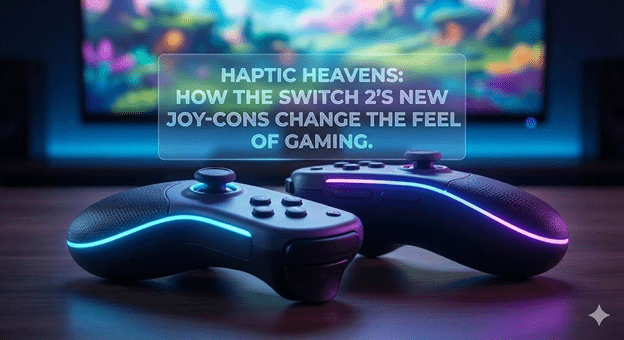
Nintendo has set a new high standard of haptic realism by designing Joy-Con 2 controllers entirely in-house. The new hardware, which is significantly more advanced than the old vibration mechanics, converts basic mechanical vibrations into intricate, textured messages. We will discuss the technology beneath the switch, the ergonomic redesigns, the engineering decisions of stick drift, and the sweeping software integrations that render the Switch 2 Joy-Cons a symbol of modern gaming hardware.
The Evolution of Tactile Feedback: Enter HD Rumble 2.0
In order to fully comprehend the monumental leap embodied by the Nintendo Switch 2, we need to see the limitations of controller vibration in history. The industry over decades has been using the Eccentric Rotating Mass (ERM) motors, the technology that made the original Playstation DualShock and N64 Rumble Pak work, which is based on rotating an off-center weight to create a generalized buzz, but has serious operation lag (100 to 200 milliseconds) and cannot independently adjust the intensity and frequency of the lock, so the experience is monotonous and binary.
Nintendo Switch 2 breaks this outmoded paradigm by introducing HD Rumble 2.0. The Joy-Con 2 uses custom Wideband Linear Resonant Actuators (LRA) synthesized using the Haptic Reactor by Alps Alpine, rather than a conventional motor, and acts more like an audio speaker. The magnetic masses are held using springs, and they move through a linear axis using electromagnetic force. This enables vibrations to be initiated and stopped in milliseconds and fully decouples the intensity of vibration as a function of frequency to produce various tactile sensations at once.
Under the Hood: The Algorithmic Magic of Joy-Con 2
The HD Rumble 2.0 is based on the advanced software of Immersion Corporation, which is TouchSense. Using the new Switch 2 software development kit (SDK), developers can access Event-Driven APIs. The hardware is capable of real-time synthesis of complicated haptic curves, rather than triggered audio waveforms, using live game physics.
Nintendo has also, more so, addressed one of the underlying physics issues with sustained haptic feedback, namely thermal decay. In conventional LRAs, extended vibration makes electromagnetic coils hot, which makes the resistance of the electricity higher and the physical output weaker. Joy-Con 2 has its own Thermal Distortion Compensation IC (Integrated Circuit). This temperature sensor chip is designed so that when the temperature is high, the chip automatically adjusts the voltage to have the same physical force in the haptic experience, so that a hit in the tenth hour of playing the game has the same physical impact as a hit in the first minute.
In combination with more sophisticated acoustic dampening materials lowering the sound by 6 decibels of mechanical noise, the physical buzzing of the controller casing never takes away attention from the two stereo spatial speakers within the console.
Ergonomics and Magnetic Bonding: A Structural Revolution
The Joy-Con 2 physical design portrays a development of the concept of the hybrid console. The new controllers are significantly bigger in size as they measure 116mm long, 41.4mm wide, and 30.7mm deep. This high volume increase translates into a comfortable, contoured grip that greatly eases fatigue in the hands during prolonged handheld use.
The obvious structural change is the total abandonment of the actual sliding rail system. It has been replaced by proprietary magnetic latching. This is to counter a colossal defect in the original Switch when it comes to durability, with the physical attaching strips wearing out or breaking. The new controllers easily slide in at the sides of the huge 7.9-inch to 8-inch LCD screen with specific magnetic circuits that will not interfere with internal electronics. Since the electrical contact points are point-symmetrical, the controllers may even be upside-down, making the Switch 2 UI automatically turn 180 degrees.
The Component Compromise: Why Not Hall Effect Joysticks?
The structural engineering trade-off of internal joystick modules remains one of the intriguing ones, despite its enormous structural enhancement. The Switch 2 Joy-Cons still use potentiometer-based analog sticks instead of the highly expected contactless Hall effect sensors.
Why be attached to technology that is prone to the notorious stick drift? When industrial CT scans are made at a high level of resolution, we can see that the Switch 2 was essentially not compatible with the new magnetic latching system in Hall effect sensors. The dense mounting magnets needed to firmly fix the 1.1-pound console would be a critical interference to the fine magnetic field sensing needed by Hall effect joysticks.
In order to curb wear, Nintendo has adopted “Smooth Analog Sticks.” They are based on the high-quality potentiometers equipped with a ring based on Polyoxymethylene (POM) inside. This gives an utterly slick movement and force, and the joystick shaft will not grind against the outer plastic casing, giving a huge quality-of-life enhancement.
Optical Sensors: Turning Joy-Cons into Mice
To further make the hardware complex is the addition of optical mouse sensors on both Joy-Con 2 controllers underneath the device. Lying the detached controller flat on a table, the Joy-Con works like a standard PC mouse.
It is an optical inclusion that fundamentally changes input possibilities. Players are able to have localized haptic feedback that changes dynamically depending on the angle and speed of the movement of their physical mouse. The right Joy-Con 2 also includes a new “C Button” which is actually a dedicated hardware launcher to the in-built GameChat functionality of the system, enabling instantaneous voice and video communication without the need to use external smartphone apps.
First and Third-Party Games Showcasing Switch 2 Haptics
The real success of HD Rumble 2.0 is that it can replicate the physical world with a feeling of physical presence with mere tactical illusion. Some flagship titles have already used this technology:
- Nintendo Switch 2 Welcome Tour: This interactive technological demonstration system challenges the actuators. In the game Maracas Physics Demo, the players are able to experience the unique switching between the lightweight clatter of plastic beads and the heavy thud of a rubber ball rolling within the grip. The haptics are so fine-tuned that in a mini-game of roulette, one can have the physical sensation of the ball physically clicking between the red and black pockets.
- Mario Kart World: Since the game has massively 24 players, open-road environments, players use Joy-Con 2 to physically feel the road surface. Switching off the smooth asphalt to the dirt shoulder alters the haptic profile of the humming high-frequency to the rattling roughness. Stored energy is also expressed by the rising haptic tension of the new “Charge Jump” mechanic.
- Donkey Kong Bonanza & Super Mario Party Jamboree: These titles apply HD Rumble 2.0 to explain the density of the destructibles and replicate the physical weight of objects that are manipulated on the screen.
- Metroid Prime 4: Beyond: Every weapon feels distinct. A regular energy beam offers a constant and increasing oscillation, whereas a shot with a missile represents an explosion of energy that stops right after being hit.
- Resident Evil Requiem: The game was designed to execute in its native quality on the RE Engine, which sends the heartbeat of the protagonist into the palms of the player during stealth scenes. Players can physically make a distinction between walking over soft carpet (a muffled pulse) and glass (a sharp crackle).
- Star Wars Outlaws & PGA Tour 2K25: Ubisoft employs the Joy-Con 2 gyroscopes to achieve the micro-aiming of handheld combat, whereas PGA Tour 2K25 employs the POM-ring enhanced joysticks to achieve the perfect, resistive swing of a golf club.
Nintendo Switch 2 Joy-Con vs. PS5 DualSense
The discussion of advanced haptics also begs the comparison of the PS5 DualSense by Sony. Both the controllers aim at the creation of a sense of immersion, but they employ radically different technologies:
- Actuator Tech: The DualSense is based on the Voice Coil Actuators (VCA), which are good at heavy, low-frequency impacts (explosions, vehicle collisions). The Switch 2 operates Wideband LRAs in its design, which adopt a craftsman approach where milliseconds of responsiveness and detailed tactile textures are highly valued.
- Battery Life: The Joy-Con 2 does not require motorized adaptive triggers or huge light bars, which gives it an unbelievable battery life of 20 hours on a tiny 500mAh battery. By comparison, the DualSense can just be charged in 4 to 6 hours.
- Trigger Design: The Switch 2 prefers fine digital bumpers with 90 degree bend rather than analog triggers and is focused on fast response and power saving.
Spatial Computing and the VR Horizon
The virtual reality (VR) and mixed reality (XR) markets have enormous potential in relation to the technological upgrades of the Switch 2. The console is an impressive VR engine with a custom Nvidia Tegra T239 SoC with 3.072 Teraflops of processing power, 12GB of LPDDR5X RAM, and Nvidia DLSS 2.2 upscaling.
The 8-inch 120Hz display can be turned into a quasi-spatial computer with third-party accessories such as the StartRC Gaming VR Headset. Nintendo is cashing in on this by featuring native stereoscopic 3D patches to The Legend of Zelda: Breath of the Wild and by adding the 1995 Virtual Boy collection into Nintendo Switch Online.
In such virtual worlds, HD Rumble 2.0 is one of the physiological requirements. The Wideband LRAs break the cognitive gap of VR by offering hyper-precise anchoring of touch. A digital sword hitting a virtual shield sends the instantaneous, lagless physical pulse of Joy-Con, convincing the brain the impact has occurred.




 SuBZeRO2K
 Spotify
 Anchor
 iTunes