
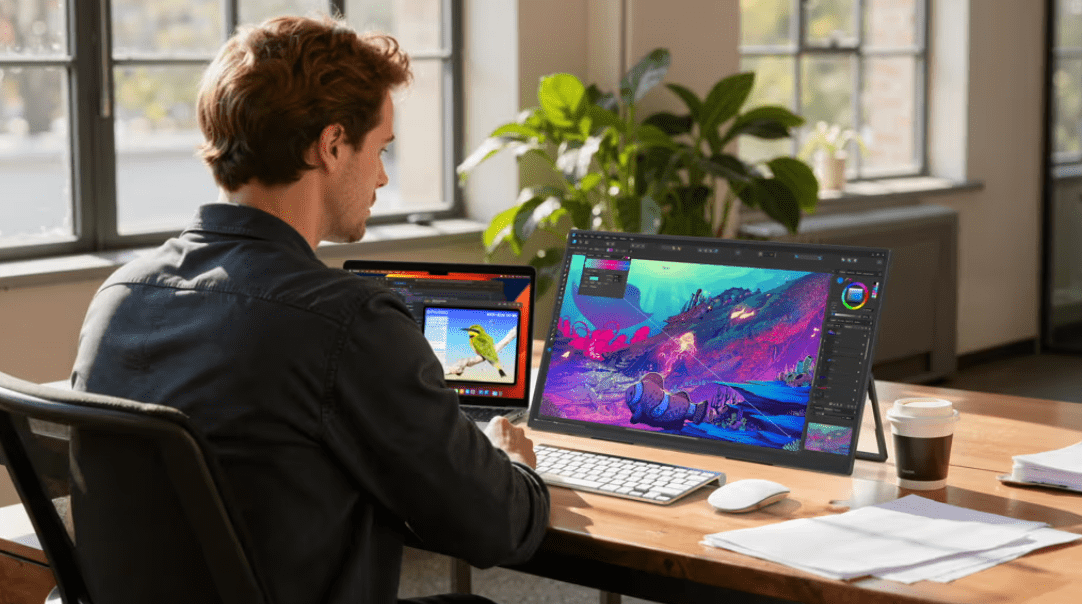
Over the past couple of years, gaming monitors have undergone considerable evolution, and one of the hottest topics in 2026 was the emergence of OLED monitors for portable devices. The concept of a portable monitor using OLED technology is rather appealing for gamers who often play away from home using consoles or portable gaming systems: the possibility of getting an excellent display with deep black tones, lightning-fast response time, and vivid colors while having a small and lightweight device looks too tempting. However, is it worth all the fuss, or does it belong to those products that are merely marketed as premium?
Why OLED Technology is Special for Portable Monitors
The OLED technology is special because, unlike conventional LCD screens, it does not have backlighting, and each pixel produces light by itself. This implies that when showing black pixels, they need to be turned off.
It means that users get true blacks along with very high contrast levels. This technology can produce the most dramatic effects during gaming sessions in horror video games or RPGs. The depth of shadows and natural lighting create an impressive visual impression in comparison with regular portable monitors.
According to the experts in display testing, OLED screens provide near-perfect instant pixel response time to minimize any potential motion blur while playing games such as shooters or racing games.
A portable monitor has a smaller display than other types of monitors, thus making the image sharper and clearer.
Gaming performance: where OLED really shines
During our tests with gaming laptops and consoles on OLED portable monitors, we found that motion control was definitely a strong point for OLED technology.
For example, fast-moving elements in games such as Call of Duty or Fortnite will look smoother than on an IPS-type monitor. Tracking enemies will be easier because there is no ghosting, and the response speed will increase.
OLED gaming monitors of today have very low input lags, up to 0.1ms in some models, which makes motion perception much clearer.
Also, input lag is very low in OLED monitors, so any command from a console controller or keyboard will appear immediately on the display. For professional gamers using a portable device, this is an important factor.
Console Gaming Experience: PS5 and Xbox on OLED Portable Screens
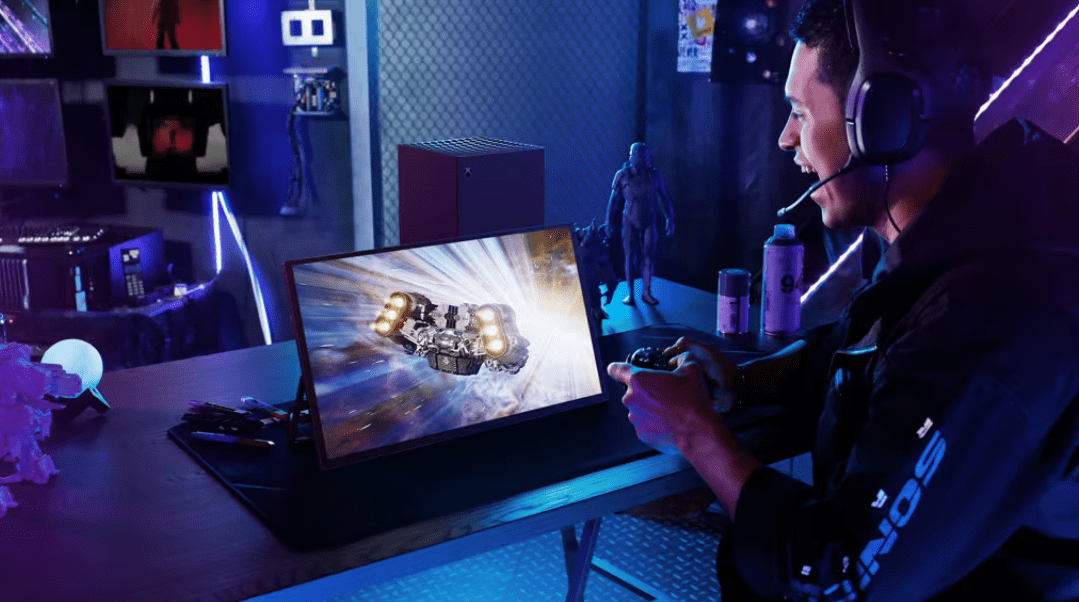
One of the biggest use cases for a portable monitor is console gaming outside the living room. Whether it’s a PS5 setup in a bedroom or an Xbox Series X connected during travel, OLED changes the experience in a noticeable way.
Games optimized for HDR look especially good. Bright highlights pop, dark areas remain detailed, and colors feel more balanced. Even smaller 15–17-inch portable OLED panels can deliver a “mini theater” experience when used in a dim room.
However, there is a catch. Most portable OLED monitors still prioritize portability over peak brightness. That means in very bright environments, like outdoor gaming or strongly lit rooms, the image may not feel as powerful as a high-end TV or mini-LED display.
Burn-in and Longevity – The Core Issue
The biggest problem that gamers have with OLED technology is burn-in. This occurs when HUD, map, or taskbar icons are on the display for extended periods.
Although burn-in was quite an issue back then, OLED technology today has seen a significant evolution. Modern screens feature pixel shifting, auto dimming, and various other protective mechanisms against potential burn-in. Some screens even boast a built-in burn-in prevention system.
In practice, burn-in isn’t as big of a problem as people think. In-game testing revealed that OLED displays can handle burn-in pretty well, especially with varying gameplay content.
However, one should note that portable gaming monitors, used for both gaming and working on spreadsheet applications or using apps with lots of user interfaces, may face some burn-in issues.
Portable OLED Monitor vs. IPS Portable Monitors
In order to evaluate if OLED would be worth your time, you have to compare it to the most popular choice: IPS portable monitors.
Even today, portable monitors based on IPS technology are widely used since they cost less, are more brilliant under certain circumstances, and don’t face any problems with burn-in. Still, they cannot compete with OLED monitors in terms of contrast and pixel reaction time.
OLED wins in:
- Motion clarity
- Contrast and blackness
- Vivid colors
- Gaming experience
IPS can outperform OLED in:
- Visibility in bright rooms
- Cost
- Burn-in prevention
- Static usage protection
This is what makes the UPERFECT 4k OLED a “premium alternative” but not an “upgrade”.
When Does the OLED Portable Monitor Lack?
Despite the advantages that OLED offers, it does have its flaws.
Firstly, brightness uniformity is not always consistent. The OLED panel tends to lower brightness for brighter areas as a way to maintain low temperatures and save energy. This becomes apparent when playing open-world games featuring vast landscapes with bright daylight scenery.
Secondly, the cost is relatively higher compared to other monitors of the same size and frequency, such as IPS.
Thirdly, the battery consumption will be higher in situations where the device uses battery-powered systems.
Hype or Real Step Forward?
Following an analysis of actual gaming performance on OLED screens compared to IPS alternatives, there is no simple answer.
While OLED is not simply marketing hype, but rather a legitimate step forward in visual capabilities, the improvement is obvious and beneficial, particularly for those who are concerned about picture quality.
However, this technology is not mandatory for all players. Casual gaming, gaming in a well-lit environment, or budget restrictions can be better reasons to consider using IPS monitors instead.
Conclusion
To sum up, the OLED portable monitors can be referred to as a luxurious gaming upgrade, but not an essential need. They provide one of the most amazing viewing experiences that can be obtained within a small device; however, they have disadvantages too in terms of price, luminance, and usability over time.
Gamers who aim to obtain the best portable experience when playing games on consoles or fast-paced games will definitely see the difference and benefit from this upgrade. For all other individuals, the upgrade may appear to be a luxury product.
By 2026, OLED technologies will have revolutionized the gaming industry by enhancing the visual performance of displays.




 SuBZeRO2K
 Spotify
 Anchor
 iTunes