
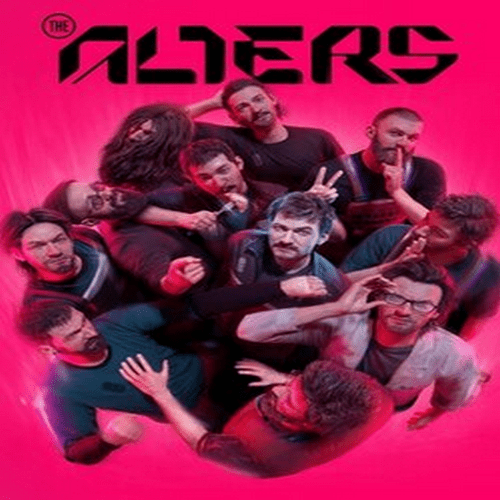
Have you ever been in a situation during daily life where you are so overwhelmingly busy that you wish you had a pair of extra hands? Or could you be in two places at once? The Alters, developed and published by 11 Bit Studios, answers these questions by thrusting you into the boots of Jan Dolski, who must create new versions of himself called ‘Alters’ to help him through an impossibly bleak situation.
Set in a dystopian sci-fi future, The Alters opens with our protagonist, Jan, waking up in a crashed landing pod, only to discover that he’s the sole survivor of the crew of Project Dolly, a mission tasked with mining the mysterious substance known as Rapidium. With little time to mourn his fallen comrades, Jan is forced to take immediate shelter in a massive, mobile base to escape the planet’s deadly radiation and the approaching sunrise, which threatens his survival.
Once inside, the base becomes Jan’s lifeline and the centrepiece of the game’s core gameplay loop. It’s a massive, rotating structure shaped like a wheel, with all the living quarters and functional modules suspended in the middle. Besides protecting Jan from harsh conditions outside, it also serves as a hub for resting, researching, and crafting. Every room has a purpose, and every system needs attention, but Jan can’t possibly manage it all alone. That’s where the Alters come in.
Jan, desperate and alone, reaches out to Ally Corp, the organisation behind Project Dolly, for help. It’s leader, Maxwell, whose voice I recognised instantly as Doug Cockle, who famously voiced Geralt of Rivia in the Witcher series. He is given a simple solution, the Rapidium.
Jan is taught how to manipulate this unstable material to create Alters. These alternate versions of himself are created after Jan uses the quantum computer on board to inspect his life path, creating branches in the timeline of his past and bringing to life a new version of Jan, one who may have studied science instead of engineering, or the one who never left his hometown to stay with his mum, these Alters come with their unique skillsets, memories, and personalities.
Each Alter has their interpretation of these events based on the life path they followed, how they handled their strained relationship with their father, their relationship with their mother, or the emotional fallout from their marriage to Lena.
Navigating each relationship is done through meaningful dialogue choices. Your answers can either alleviate their fears or anxieties or make them worse; if you are aggressive towards them, you’ll start to build rebellion. Some of the Alters take their newfound existence quite well, such as the scientist who views the situation as a positive, whereas others struggle with an identity crisis. It’s a fascinating character study of the many different versions of Jan, and I enjoyed each interaction.
But managing the Alters isn’t as simple as giving orders. Suppose their happiness drops too low, usually because their personal space isn’t up to standard. In that case, they are being made to work crunch hours, which I’m amazed you can do, or their requests are being ignored, such as a request to add a social room for the Alters to relax, watch a movie together and even play some beer pong which was a fun mini-game that got harder the drunker you got.
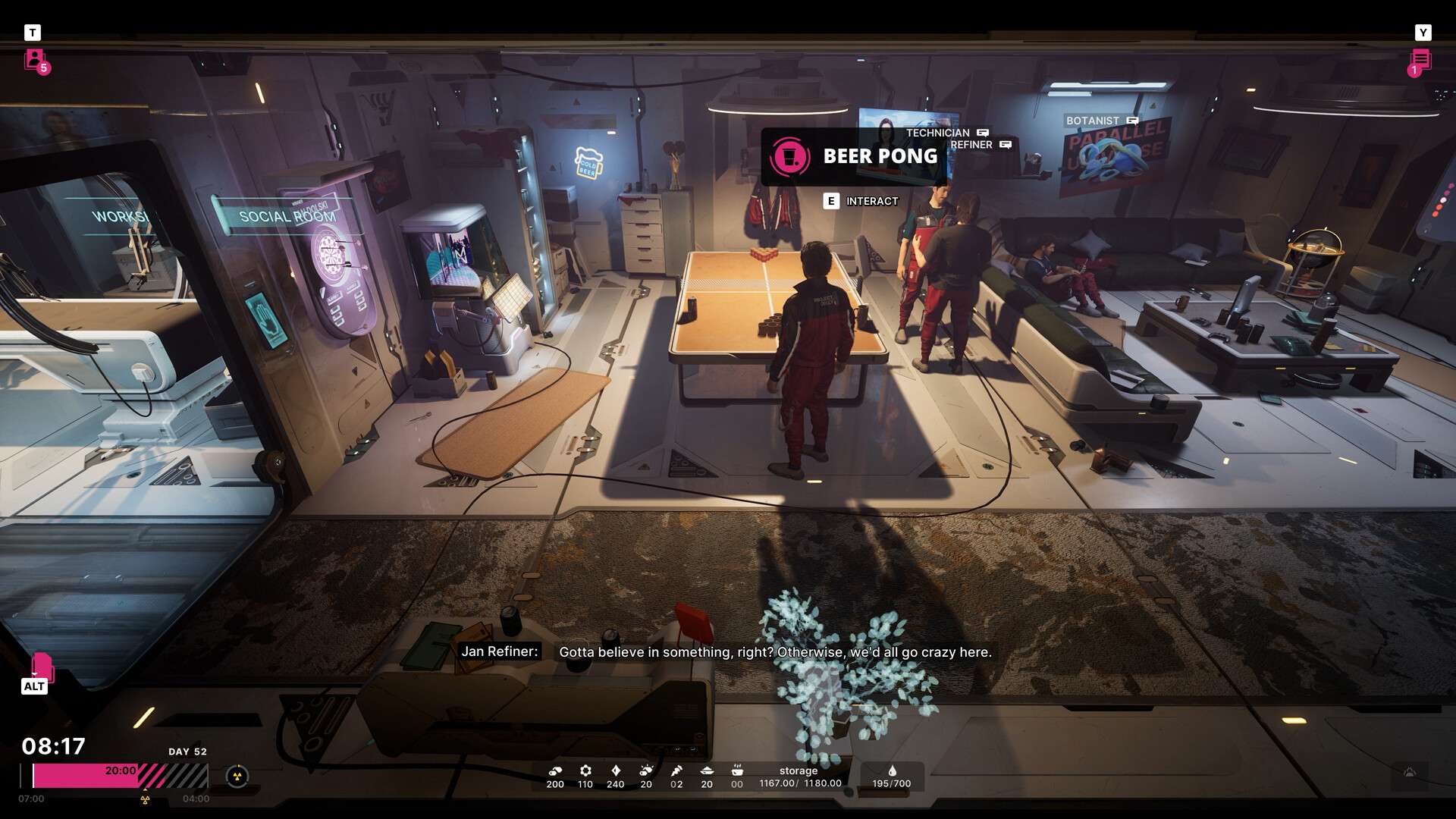
They can rebel, refusing to work or even turning against you. You’re given a deadline of a few in-game days to improve their happiness or fulfil their requests. During my time with the game, I always chose the latter, listening to them, understanding their frustrations, and giving them what they wanted. And that choice made every interaction feel that much more personal.
Base management quickly becomes a crucial part of survival. The more rooms you add, the dormitory, research labs, or storage rooms, the heavier the base becomes, increasing the energy and resources required to keep everything running. It didn’t take long before I realised I needed to start paying more attention to the numbers.
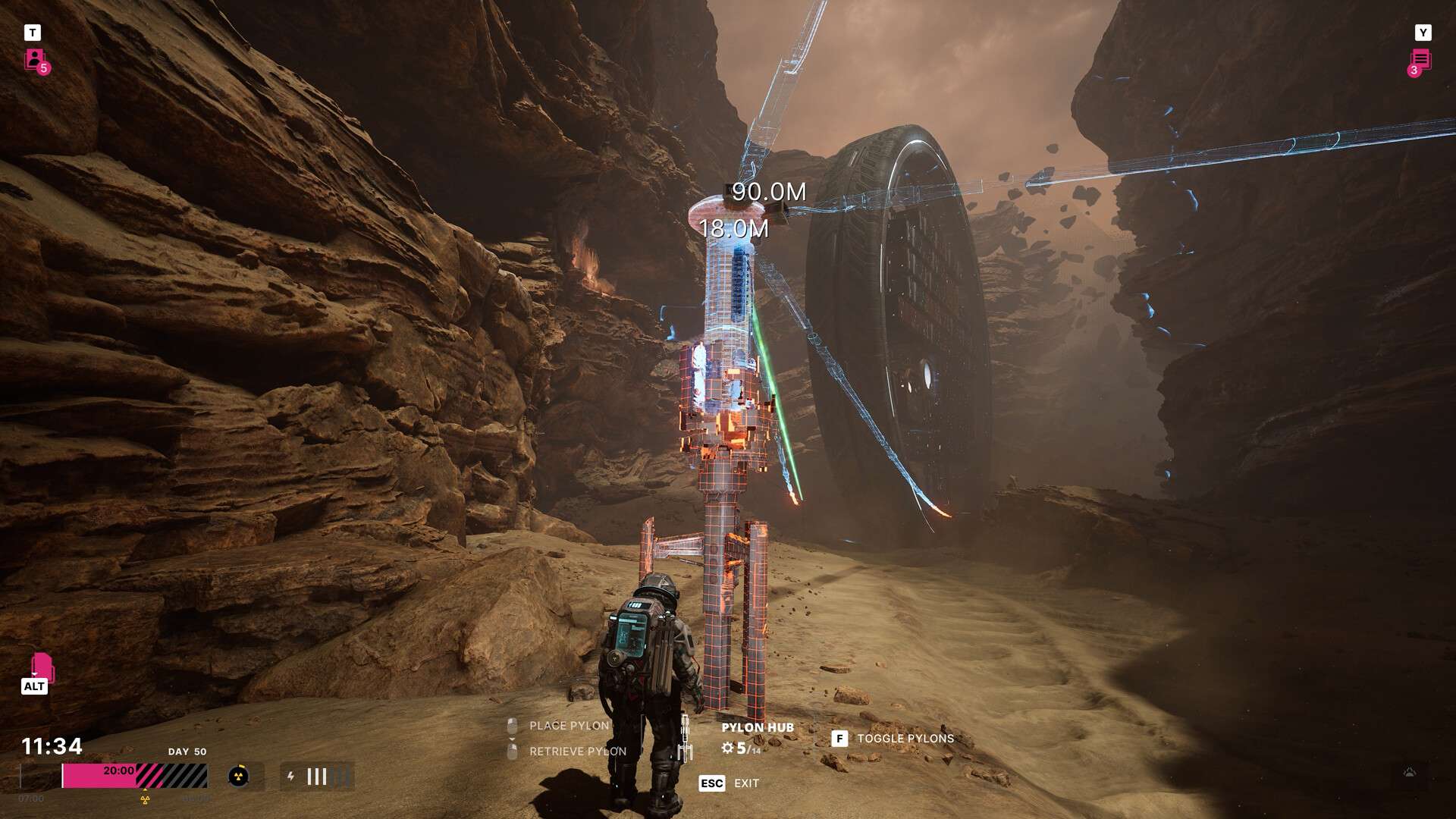
Assign Alters to undertake tasks and have the scientist research upgrades that unlock new modules or improve efficiency, such as better batteries. You can even send the miner or technician Alter outside to operate the remote mining outpost, which was very fun to set up as you connect each pylon back to your base. These gather the valuable metals, organics, minerals, and Rapidium you need.
Time management is just as vital as resource management. There are only so many hours in a day, and every action, whether crafting tech in the workshop or sending an Alter to work a mining outpost, takes time. However, when you commit to a task, time fast-forwards until it’s complete. Push past 9 PM, and fatigue starts to set in, slowing your productivity. Ignore it for too long, and you’ll become exhausted, reducing efficiency and risking mistakes.
Staying outside after dark is even riskier. Radiation levels begin to climb rapidly, and while your mobile base offers shielding to mitigate exposure, that system relies on batteries that need to be regularly recharged. Things get especially dangerous during magnetic storms, which drain your batteries faster and damage rooms and modules across your base. Repair kits become essential, so keeping a steady supply is a must.
Thankfully, the Uphold Production mechanic makes this easier by allowing you to maintain a crafting queue, ensuring key items are constantly replenished in the background, keeping everyone happy and everything running.
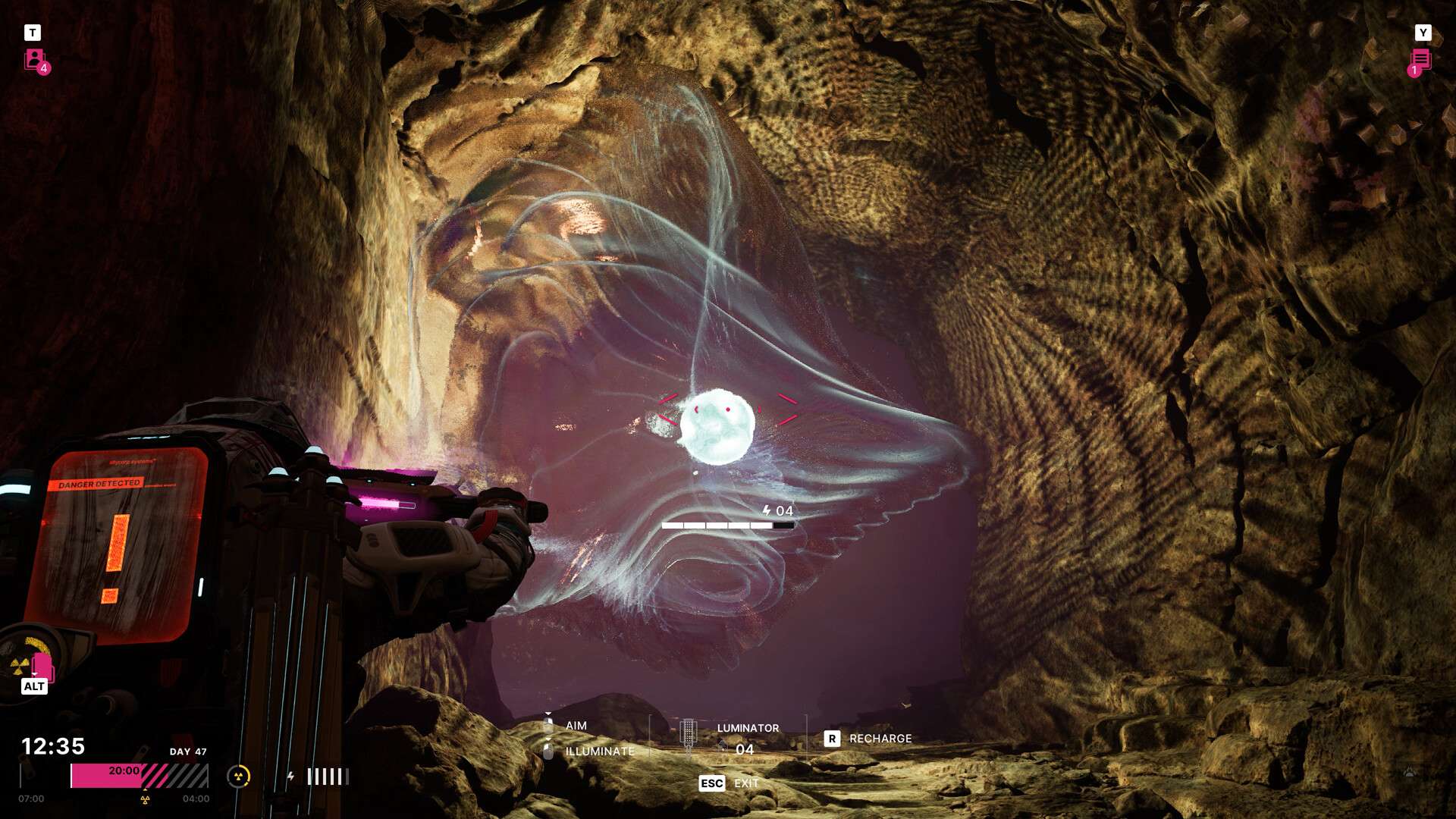
And while exploring outside, you’ll encounter anomalies. Some of these are harmless, while others damage you with radiation. A special tool known as the Luminator proves particularly useful after consulting with the scientist to research and craft it. This tool allows you to dispel anomalies, providing rare materials that can be used to further research new technology and upgrade your base.
Unfortunately, I encountered some performance hiccups outside and inside the base, including frame drops and clumsiness. There were also some minor typos during dialogue or menu navigation, which broke my immersion from time to time. Visually, however, The Alters is stunning. The harsh, alien planet outside the base is as haunting as it is beautiful; lava rivers, dark, cloudy skies, and strange natural formations are all brought to life with impressive environmental detail.
Inside the base, the design leans into industrial sci-fi, full of cold metal, humming machinery, and atmospheric lighting that reinforces the tone of isolation. Accompanying it all is a moody synth soundtrack that perfectly suits the setting.
Overall, The Alters is a personal sci-fi survival game that is as much a character study as a base management sim. It weaves storytelling with a satisfying gameplay loop in which your decisions and choices have actual consequences for the mission’s outcome. It’s an indie game that should not be slept on in 2025.

The Good
- Deep narrative where decisions matter
- Gameplay loop always keeps you on edge
- Brilliant character study of very different personalities
- A lot of mechanics, but each is easy to understand
The Bad
- Some performance hiccups
- Small typos




 SuBZeRO2K
 Spotify
 Anchor
 iTunes