
There is a certain thrill that comes only from pushing a bike past its comfort zone, with the engine screaming, reflexes razor-sharp, and zero room for error. “LANESPLIT” captures that raw, white-knuckle rush where every decision matters and one wrong move can end the run in an instant. Developed and published by FunkyMouse, this high-octane experience is all about testing your limits, threading the needle through traffic and seeing how far you can take it before disaster strikes.
The game is built around high-speed, score-chasing runs across three maps, with a lineup of fourteen bikes ranging from scooters to dirt bikes and road bikes. Each bike handles differently, encouraging players to experiment based on speed, traffic density, and weather conditions. Customisation is fairly limited, offering colour changes and a couple of handlebar and wheel options, with all the bikes non-branded. The progression is tied directly to performance. New bikes are unlocked by achieving higher scores during runs; some require milestone scores, such as hitting 100,000 points in a single run.
This system fits well with the arcade-style design and gives players a clear goal to pursue while improving their skills. The core gameplay rewards speed and precision. The faster you ride, the higher your score gets, and the bigger rewards with faster bikes you can unlock, but crashing or slowing down will instantly reset your current score, which is heartbreaking when you have those higher scores. While the overall flow is quite solid, there are a couple of technical hiccups: barriers you can clip through, and you end up off the road, where steering becomes nonexistent, which turns into frustration.
I was unable to test the multiplayer aspect of the game because we received an early release. It allows you to ride with your friends, competing for the highest score, which is tracked on a global leaderboard, adding some competitive nature to the game.

Multiple weather and traffic settings have been added to add some spice and variety to the game. The dry conditions favour top speed and more agile handling, whereas in wet weather, you need to make sure you get a bike that handles well and the brakes work, or you will end up off the road.
If you want to test out the roads without the frustration of traffic, you can do “Zen Mode,” which removes all the vehicles so you can hit high speed and see how quickly you can take the bends. “Rush Hour” mode is the complete opposite, as the name might suggest, with mass traffic, and you need to be one hundred percent locked into the game.
You might be thinking all you need to do is ride your bike through traffic as fast as possible and get the highest score without crashing. How hard could it be? Well, the controls are intentionally minimal and easy to pick up. You need to steer, accelerate, and brake while focusing on precise positioning to split the lanes at some abnormal speeds, and for anyone who has ridden a road bike before, you will understand that the faster you go, the easier the bike is to split lanes, which does not make sense, but trust me, it’s a process.
Each bike offers different handling characteristics, meaning upgrades are more about choosing the right machine for the conditions rather than improving stats mid-run. I liked that you could switch between manual and automatic, and manual added another level of difficulty and was actually some great fun compared to automatic, where you just hold down W and send it forward while turning with A and D, with S being the brake.
LANESPLIT uses a more stylised, slightly vintage art style with a very simple, muted colour palette that works well with the game’s high-speed focus. The maps all have a dark theme with a vintage-style filter, giving the environments a distinct look that suits the experience and helps convey a sense of speed. Weather effects like rain change visibility, adding extra tension to the ride with wet road reflections and reduced sightlines, making an already tight gap even riskier. The environments are mostly highways and roads designed to be read quickly rather than admired.
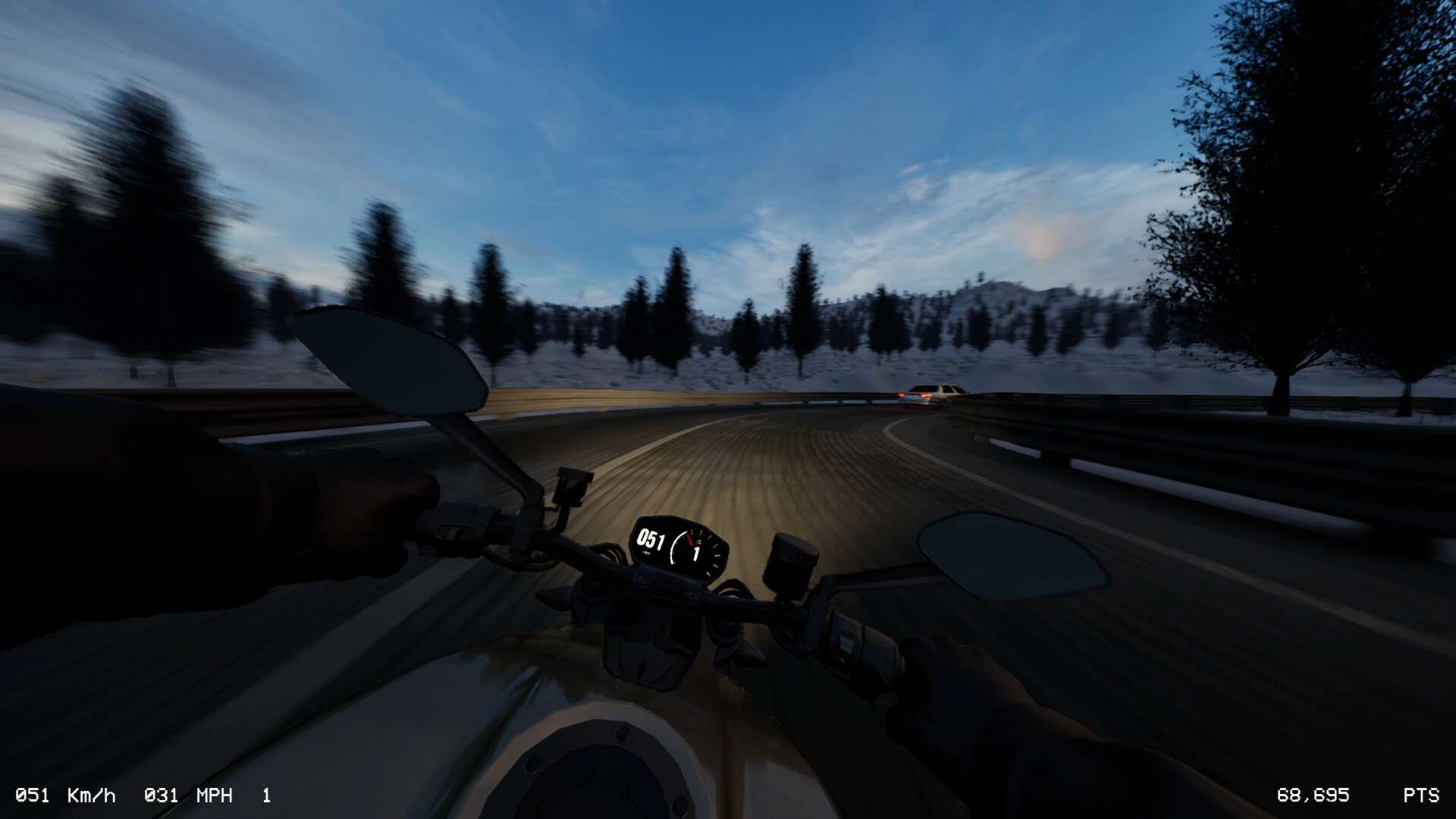
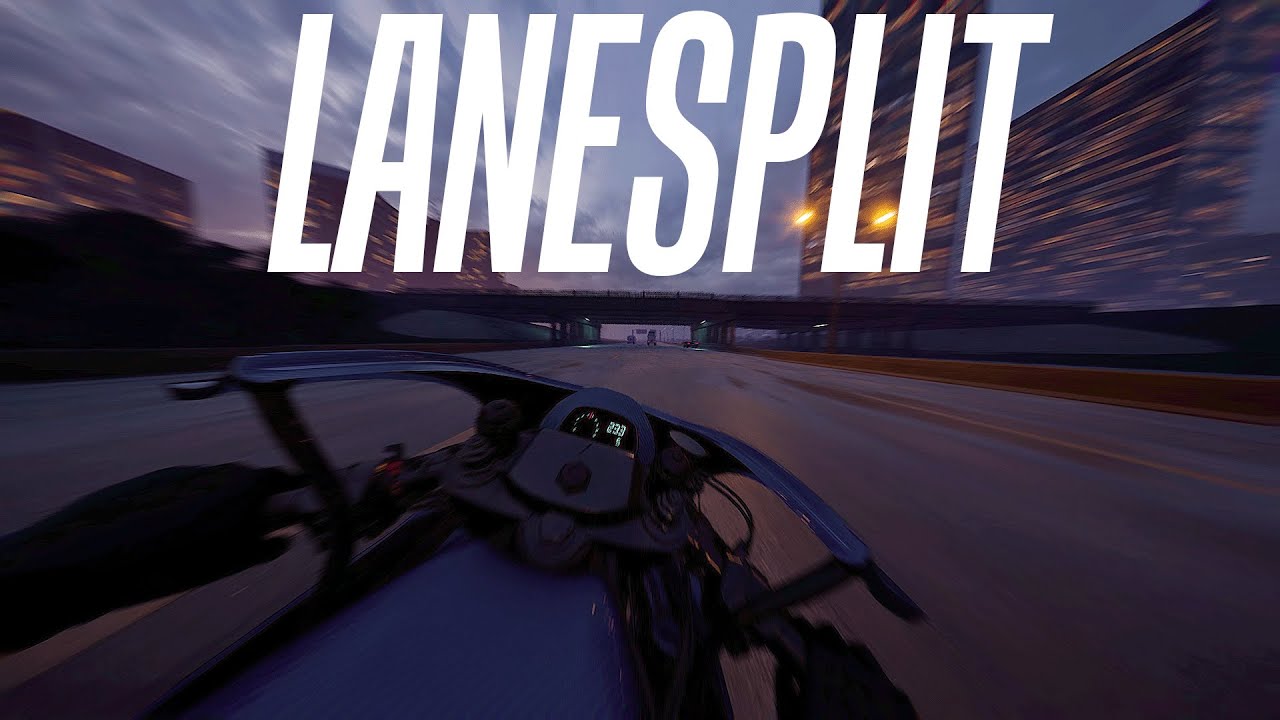
The cars all look fairly generic, but you’re normally moving that fast; this rarely stood out, and all you really notice is the headlights, tailights, and the gaps in traffic. The motorbike models, however, could have benefited from more work; the detail was lacking, and given that the centrepiece of the game was disappointing, there wasn’t much texture work put into them. I’ll put one standout feature in the game: the loading screen, which features a long, VHS-style, 90s-themed highway video. Even though the load times are long, this retro presentation is a cool addition.
While the world is turning into a blur, LANESPLIT pulls you into a strong flow with its drum-and-bass soundtrack, which gets louder and louder the faster you’re going, and if you crash, it abruptly stops straight away. The bikes themselves sounded very generic, and their rev limit just sounded off. While there are slight differences between engines, they’re often drowned out by the soundtrack, which tends to overpower the bike’s audio as it gets louder and more aggressive.
This made riding the bike feel a little less mechanical, especially because the bikes are the main attraction. The environmental audio is very minimal; there is no traffic, wind, or impact noise, which takes away much of the game’s thrill. Even the occasional horn honk from a vehicle would be nice. Atmospherically, the sound design complements the visuals well and adds some intensity to the game, but I would have liked to see a better balance between the soundtrack and bike audio.
LANESPLIT delivers a focused, adrenaline-fuelled arcade experience that thrives on speed, risk, and flow. While its presentation, soundtrack, and score-chasing gameplay loop do a great job of selling the thrill of land splitting at extreme speeds, technical hiccups and a lack of depth in bike detail and audio balance hold it back from reaching its full potential. Despite the flaws, it’s a tense, satisfying ride that knows exactly what it wants to be fast, punishing in and addictive in short bursts. The developers will need to make sure they’re keeping content coming.
The Good
- Addictive, high-speed score-chasing gameplay
- Strong sense of speed and flow
- Drum and bass soundtrack that reacts to acceleration
- Multiple bikes with distinct handling styles
- Retro, VHS-style presentation fits the tone well
The Bad
- Motorbike models lack texture and detail
- Bike audio feels generic and is often drowned out by music
- Minimal environmental sound design




 SuBZeRO2K
 Spotify
 Anchor
 iTunes