
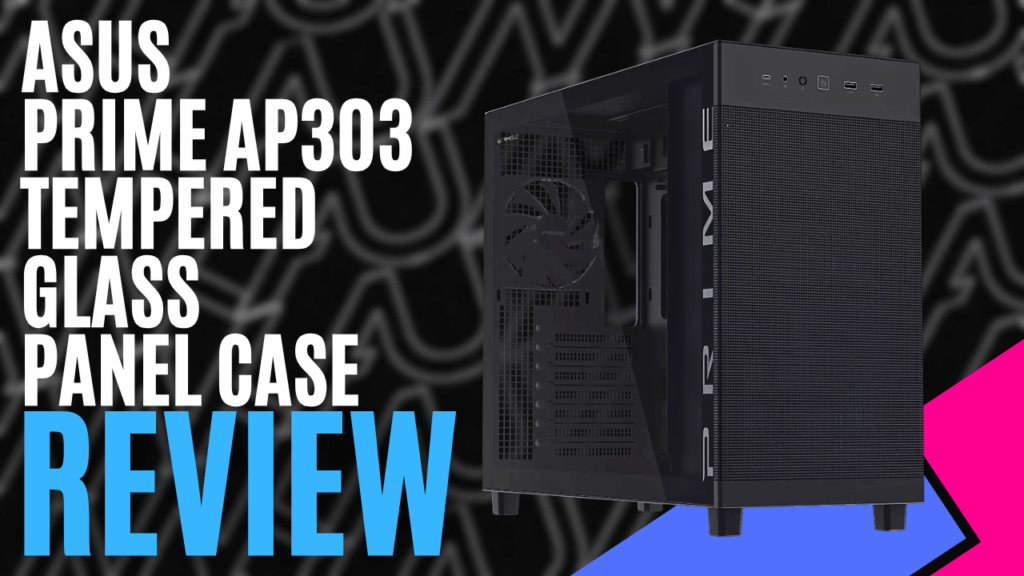
Finding the right balance between size and usability in a PC case isn’t always easy. Go too small, and you start running into compromises pretty quickly. Go too big, and you’re back to dealing with a bulky full tower. The ASUS Prime AP303 Case looks to sit somewhere in the middle, offering full ATX support without taking over your desk.
The case keeps things clean and understated, avoiding the overly aggressive gamer aesthetic. Instead, they’ve opted for a more neutral look that would sit comfortably in just about any setup. We received the version with a tempered glass side panel, offering an unobstructed view of the internal components, while the rest of the design matches the mesh version, helping maintain airflow without disrupting that minimal style.
Despite its relatively compact 44-litre footprint, it can still support Mini-ITX, Micro-ATX, and full ATX motherboards, offering a lot of flexibility for different build types. Clearance is generous too, with room for graphics cards up to 360mm in length, a 360mm AIO cooler, or CPU coolers up to 165mm tall, so you’re not making all of the usual sacrifices when stepping down from a full tower.
Having said that, you may have to make a small sacrifice on your chosen power supply. Rather than the usual mounting place at the rear, there is a dedicated section at the front of the case, with an internal extension lead that connects to the rear panel.

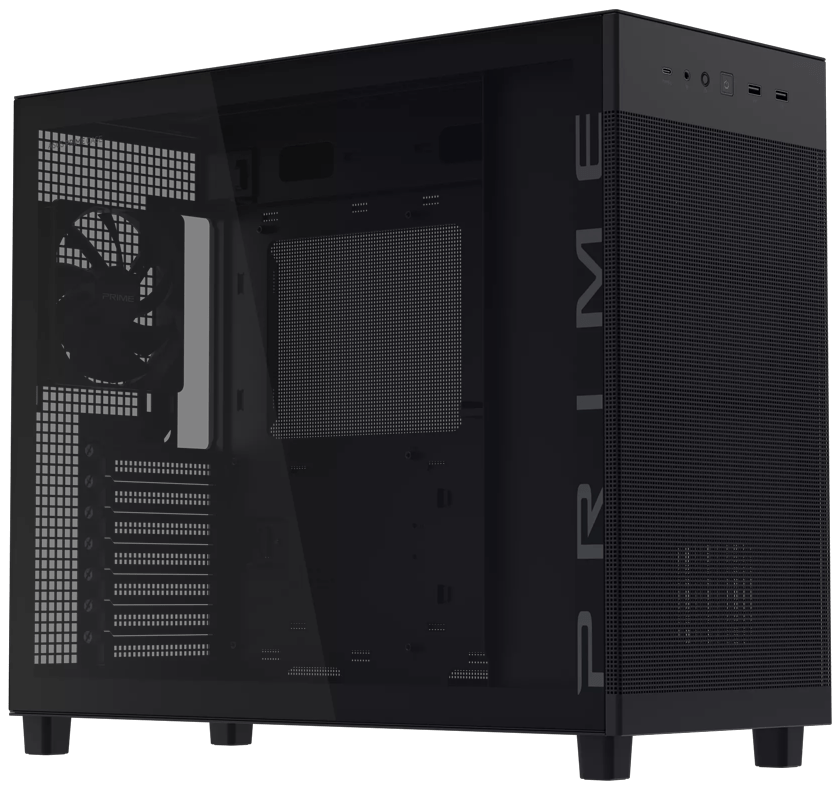
It will fit power supplies up to 180mm, and because of the positioning and design, you won’t be able to attach front-mounted cooling options, which does limit radiator placement compared to more traditional layouts.
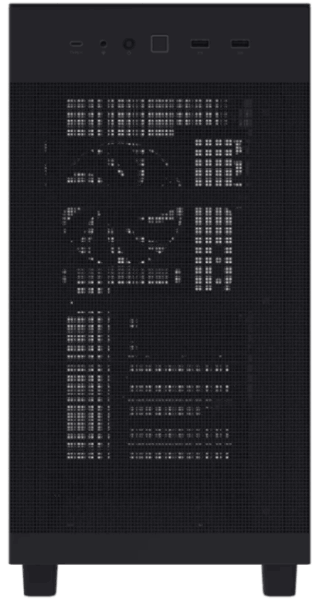
Making up for this is that most of the case is a quasi-filter mesh, so airflow isn’t as restricted as in other cases, and they’re all easy to remove and clean. You can also mount up to seven fans in the chassis, though it comes with only a single 120mm fan preinstalled at the rear.
It’s not a terrible starting point, and it’s alright for less demanding builds, but if you’re pushing a system that’s going to generate some heat, you’ll want to make use of the 120x360mm mounting options on the top and bottom panels.
The front I/O panel is somewhat standard these days, with a USB 3.2 Gen 2×2 Type-C port capable of up to 20Gbps transfer speeds, alongside two USB 3.2 Gen 1 ports and a combined audio jack. Having that high-speed Type-C connection on the front panel is a welcome inclusion, and using a unified front I/O header simplifies one of the more fiddly parts of building a PC.
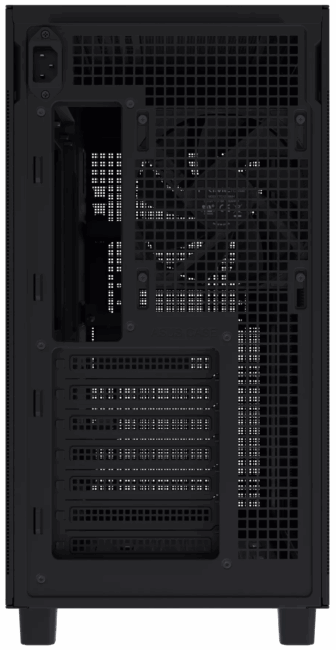
Building inside the ASUS Prime AP303 Tempered Glass Panel Case is a fairly straightforward experience. Tool-free panels make access quick and painless, whether you’re building from the ground up or swapping out a component. With 34mm of space behind the motherboard tray, struggling with cable management is a thing of the past.
As GPUs get larger and heavier, GPU sag is a genuine concern, but ASUS addresses this by including a bracket designed to stabilise larger cards, particularly those in the 310mm to 360mm range.
Alternatively, they’ve also included a bracket that replaces a section of the rear expansion slots to vertically mount your GPU. It’s a small addition on paper, but one that can make a big difference in maintaining the longevity and presentation of your build.
While there are a few compromises to keep in mind, particularly around power supply placement and out-of-the-box cooling, they feel like reasonable trade-offs given what the case offers. The ASUS Prime AP303 Case strikes a solid balance between compact design and full ATX compatibility, making it a great option for builders who want to save space without limiting their component choices.

The Good
- Supports Mini-ITX through full ATX in a compact footprint
- Generous GPU clearance with included support bracket
- Strong airflow potential with flexible fan/radiator support
- Clean, understated design
- Excellent cable management and tool-free access
The Bad
- Front-mounted PSU limits cooling configurations
- Only one fan included out of the box
- Requires additional investment for optimal cooling







 SuBZeRO2K
 Spotify
 Anchor
 iTunes