
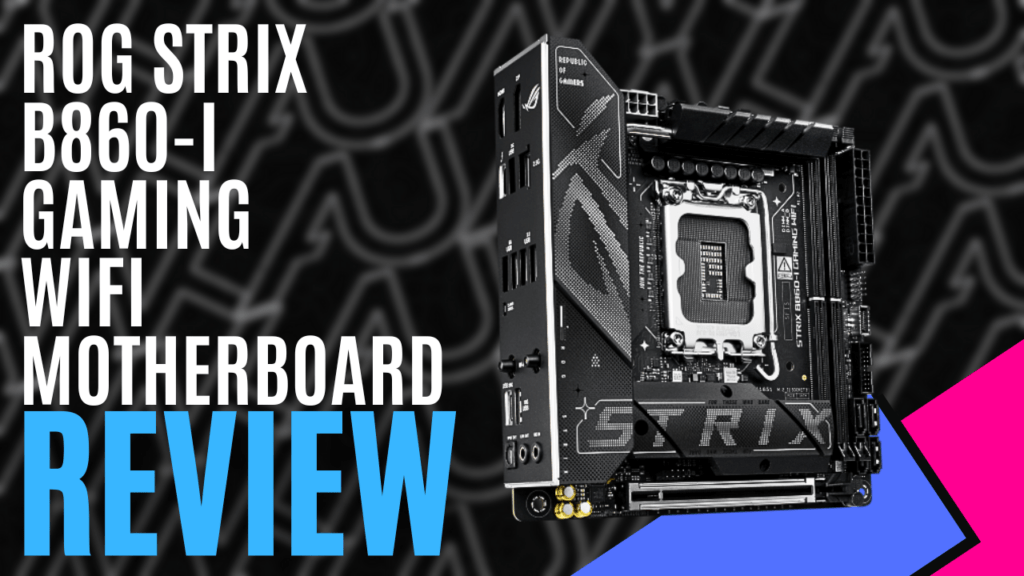
When it comes to building a compact yet uncompromising gaming PC, the choice of motherboard is perhaps the most critical decision of all. Small form factor builds demand for a balance of performance, connectivity, and thermal efficiency, all without the luxury of wasted space. The ROG STRIX B860-I Gaming WiFi motherboard enters the scene as ASUS’s latest Mini-ITX contender, and it’s one that immediately sets out to prove you don’t have to compromise just because you’re going small.
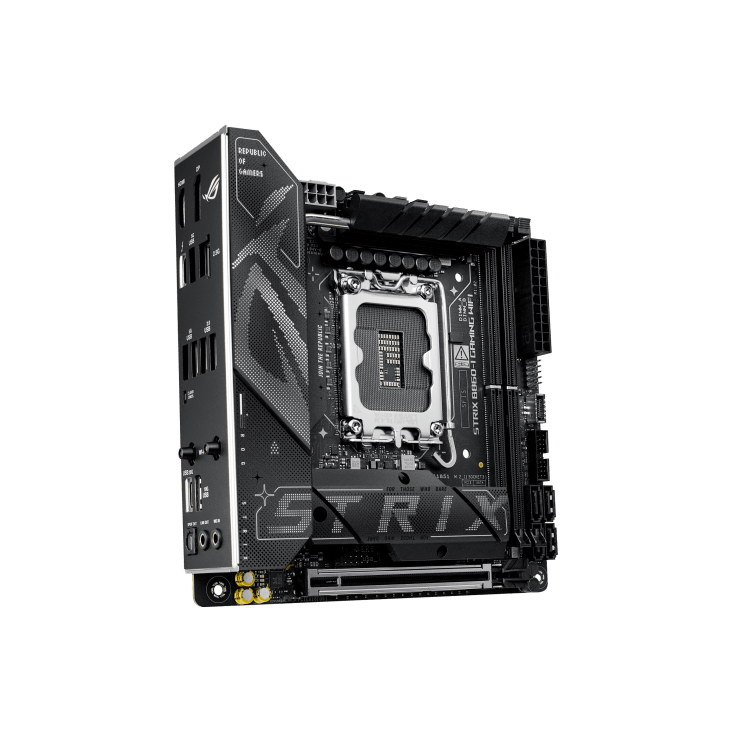
Designed around Intel’s new Core Ultra processors and built to harness both next-gen AI capabilities and the ever-growing demands of modern gaming, the ROG STRIX B860-I Gaming WiFi seems almost too ambitious for its tiny 17 x 17 cm footprint. This isn’t a stripped-back “budget ITX” option — instead, ASUS treats it as a flagship in miniature.
Despite being smaller than most paperback novels, the board packs in some impressive firepower. It supports up to 128GB of DDR5 memory across two DIMM slots, pushing speeds beyond 9066 MT/s thanks to Intel XMP and ASUS’s Enhanced Memory Profile III. The inclusion of asynchronous clocking means memory tuning can occur independently of the CPU base clocks, allowing enthusiasts to squeeze out higher performance without sacrificing stability.
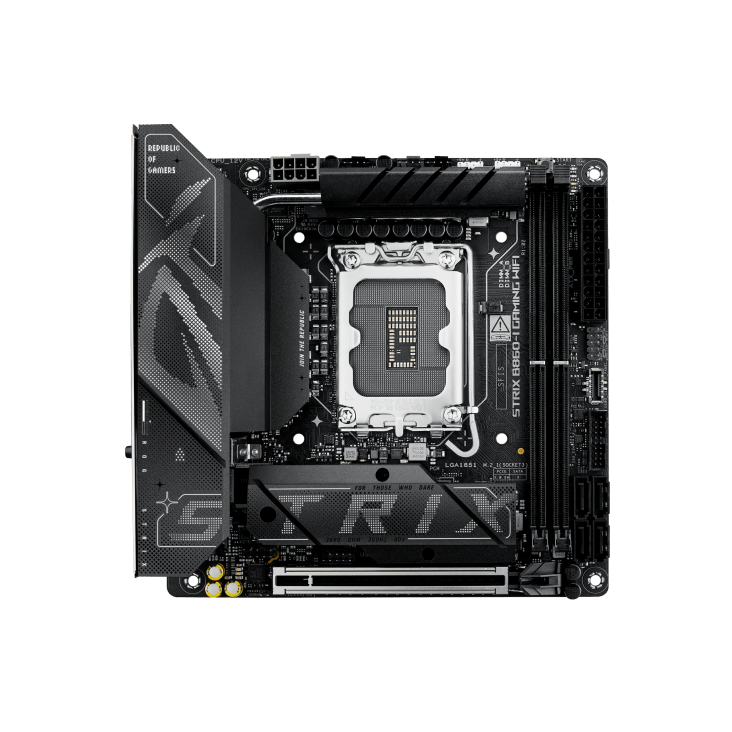
With support for Intel’s Core Ultra Series 2 processors, the board taps into NPU acceleration and ASUS’s NPU Boost feature. Overclocking AI cores isn’t something we’ve seen widely available before, but with a single click in the BIOS, you can push up to 24% more performance in AI workloads.
It’s an exciting glimpse into where PC hardware is heading, and ASUS is clearly positioning this board as a platform not just for gamers, but also for creators who want to leverage AI-driven tools.
Despite its size, the ROG STRIX B860-I Gaming WiFi doesn’t cut corners on storage. There are two M.2 slots: one is wired for PCIe 5.0 x4 and cooled with a dedicated heatsink, and the other is located on the back of the board with PCIe 4.0 x4 support. ASUS’s tool-free Q-Latch system makes installation quick and painless, while four SATA ports offer extra flexibility for traditional drives at 6Gb/s.
For graphics, there’s a single reinforced PCIe 5.0 x16 slot with the ASUS SafeSlot design. In most ITX builds, one GPU slot is more than enough, but clearance can be a headache. To make life easier, ASUS has included the Q-Release Slim, so swapping out a card doesn’t mean fumbling with a screwdriver in cramped case space. It’s a small touch, but one that seasoned builders will appreciate.
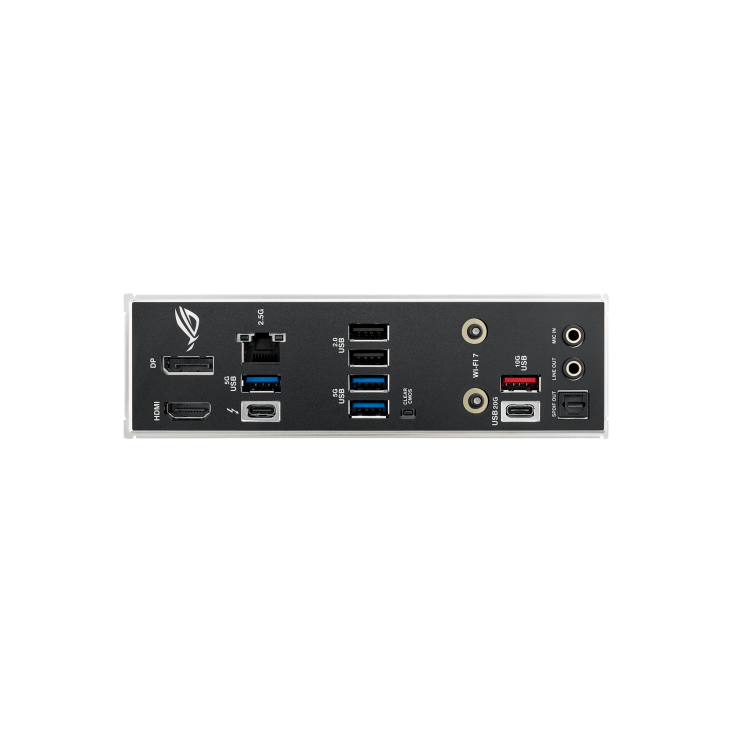
Connectivity is another area where this board excels. You get Intel 2.5Gb Ethernet alongside WiFi 7 support, paired with ASUS’s Q-Antenna for easier installation and stronger reception.
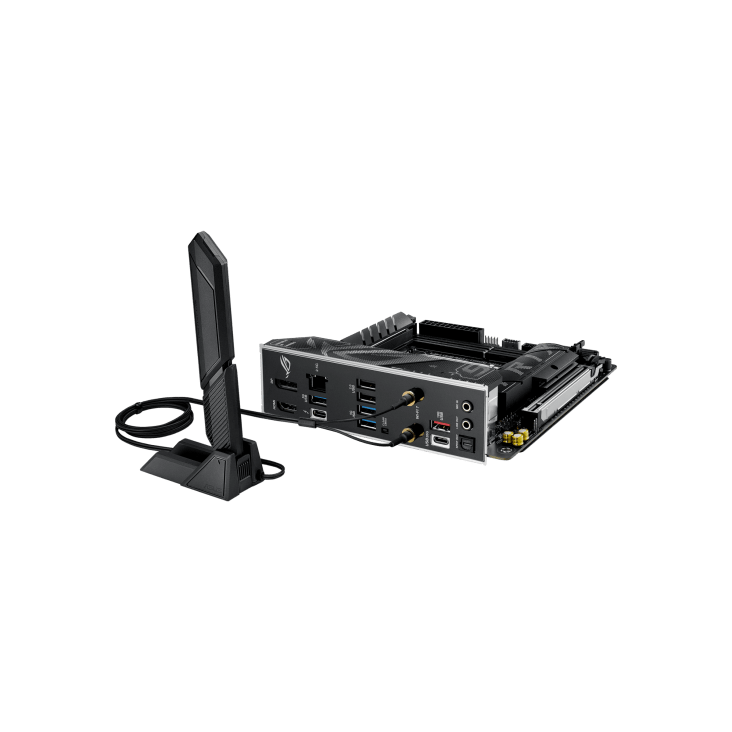
AI Networking II further enhances this by intelligently prioritising bandwidth depending on the task at hand. At the same time, Armoury Crate ties everything together with a host of additional tuning and monitoring options.
The rear I/O is impressively stacked for a Mini-ITX design. Eight USB ports cover everything from Thunderbolt 4 and USB-C with 20Gbps transfer speeds, through to a 10Gbps Type-A, multiple 5Gbps ports, and even a couple of legacy USB 2.0 options. Up front, you’ll find a 10Gbps USB-C header and more USB 5Gbps and 2.0 connections. For display, HDMI 2.1 and DisplayPort 1.4 provide support for those relying on integrated graphics, while Thunderbolt video output adds even more flexibility.
Round it out with premium audio via the Realtek ALC1220P codec, SupremeFX shielding, and Dolby Atmos support, and it’s clear ASUS hasn’t overlooked entertainment quality either. Whether you’re gaming, streaming, or simply listening to music, onboard sound feels well above “just good enough.”
For builders looking to craft a powerful, compact gaming PC that doesn’t compromise on connectivity or future-proofing, the ROG STRIX B860-I Gaming WiFi motherboard is a worthy contender if you’re going for an Intel build. It manages to juggle next-gen CPU and memory support, PCIe 5.0 storage and graphics, WiFi 7, premium audio, and a genuinely useful suite of AI-enhanced features, all without cutting corners on build quality or usability.

The Good
- Full-featured Mini-ITX board
- PCIe 5.0 for GPU and storage
- Easy-to-DIY ASUS Q-systems
- Excellent connectivity
The Bad
- Limited expandability due to size/fewer slots





 SuBZeRO2K
 Spotify
 Anchor
 iTunes