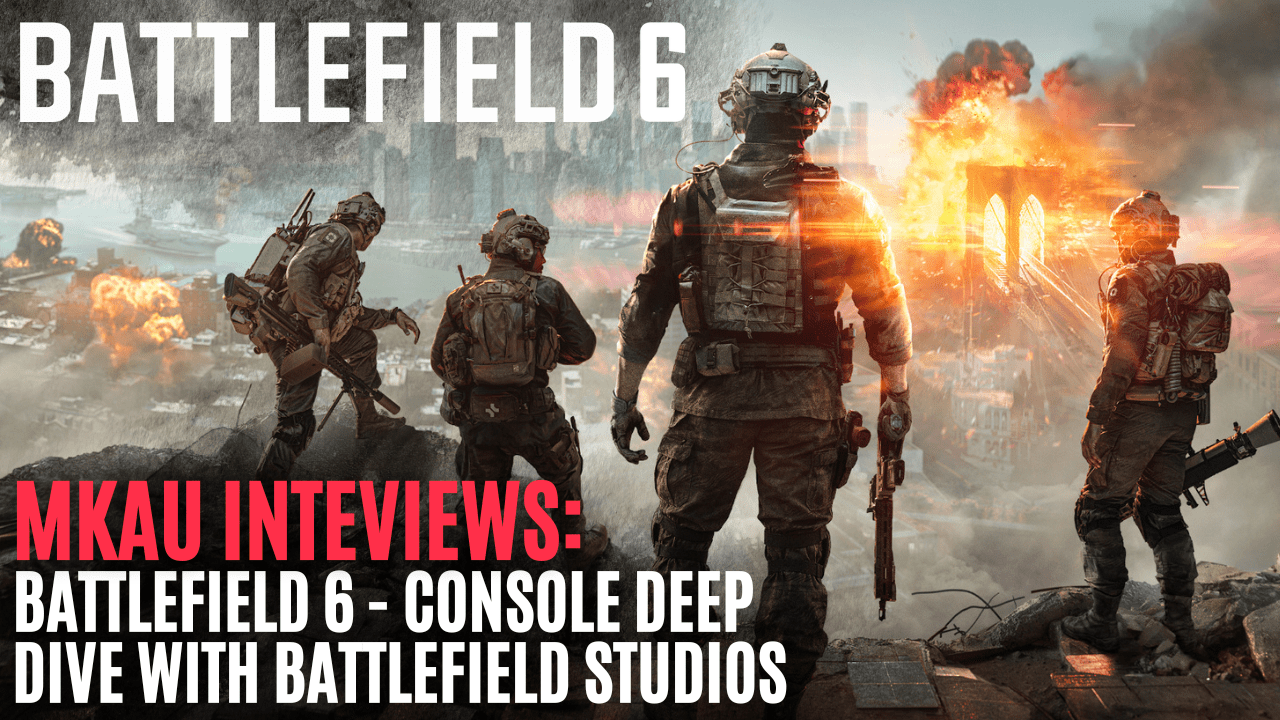
The battlelines are drawn, and the mess hall is filling with many enthusiastic gamers awaiting the release of ‘Battlefield 6’. Developers at Battlefield Studios (Criterion, DICE, Motive, and Ripple Effect) are hard at work to ensure that this Battlefield installment provides the most comparable experience across all platforms as they prepare to launch ‘Battlefield 6’ on October 11. While many of you have likely spent hours participating in the multiplayer beta weekends, testing gameplay and features ahead of launch, you now have the full experience just around the corner, promising countless battles and unforgettable moments.
Earlier last week, MKAU Gaming was allowed to sit down with Christian Buhl (Studio Technical Director) and Matthew Nickerson (Designer) from Battlefield Studios to discuss what players can expect from the console experience in Battlefield 6.
Given that this was the first opportunity I’ve had to sit down and chat with such esteemed guests, you could safely assume that I was full of nerves heading into the interview; however, I gained a lot and developed some valuable understanding of a misconception I had regarding building destruction. You see, after watching the Battlefield 6 reveal trailer and seeing all the wondrous destruction unfolding, I developed grand plans to lay waste to the masses by bringing down many a building and crushing my opponents. However, after many hours trying to do so during the multiplayer beta weekends and only managing to decimate a few people holding up in a small shack, it certainly left me with questions about how the destruction works.
To set my mind at ease and understand why I wasn’t able to level absolutely everything, I asked, “I noticed during gameplay in the beta that not everything was destructible. Is that a technical limitation or a purposeful design choice?”
Christian: “I think the short answer is that it wasn’t really a technical constraint, that was more of a design decision, right, like we didn’t want you to be able to destroy absolutely everything in a level, and by the level, it’s just a flat pile of rubble.”
Matthew: “Yeah, the one thing that we were really cognisant of here is that we wanted destruction that changed gameplay elements, that opened up new routes for players to take, but we also didn’t want to have at the end of the game a destroyed flat plain. We wanted to keep sight lines intact for tactical purposes and the range of weapons, and for our sandbox overall, we reviewed that to be the healthiest measure for gameplay across all modes, and so there are things that we do not allow to be destroyed for those main reasons.”
Moving on to one of the more important topics of conversation that I’m sure many of you highly regard, Quality and performance modes. After all, frames win games, am I right? “On consoles, what sort of framerates can we expect to be seeing across the quality and performance modes?”
Christian: “So, for Xbox Series X/S, PlayStation 5, and PlayStation 5 Pro, you’ll be able to select between fidelity mode and performance mode. The Xbox Series S will kind of only have the one option, but basically, if you choose the fidelity mode, we are going to target 60 frames per second. Obviously, you’ll be able to run at a little bit higher resolution, maybe higher detail, higher settings, but we are still targeting 60 frames per second when you select that mode. If you select performance mode, we are targeting 80 frames or more per second. As I mentioned earlier, we’ve been doing testing for a long time and a lot of evaluation on performance, and our goal was that when you target 60 frames per second, that’s what you’re going to get almost all the time. We are really happy with the performance we’re getting at the targets we’re setting”.
Adam Ryan of WellPlayed – A Unique Aussie Take On Gaming, who also attended, had some brilliant questions that shed a lot of light on the focus on a fair and comparable experience, no matter where you decide to play, asking, “What were some of the struggles you faced trying to achieve parity across all platforms?”
Christian: “I can talk a little bit about some of the technical stuff around hardware, and then Matthew can talk more about the controller input stuff. I’ll start by saying that our approach from the very beginning was that we wanted to focus on performance and stability, and we wanted to treat console and PC as equal targets for the game. In the past, I think Battlefield has approached consoles as a port of the PC game: We build the PC game, we port it to consoles. We didn’t want to do that this time. We wanted those to be just more target platforms than we needed to hit. We have massive farms of PCs across various specs and all the console hardware we’re targeting, including Xbox Series S, Series X, PlayStation 5, and PlayStation 5 Pro, on which we constantly run the game on. And from the beginning, our goal was to keep the game performing and stable at a high level.
Of course, that goes up and down over time. But rather than saying, “hey, let’s build a bunch of cool shit and put it in the game,” and then at the very end try to get it to work, we said, “we’re not going to add too much stuff to the game until we get it to work and perform well.” Throughout the entire process, we were constantly pausing, updating, fixing performance, and getting it to where it needed to be. Hopefully, you saw that payoff at the open beta, where the PC game performed extremely well and the console games performed extremely well.
Obviously, we’re used to developing across different levels of hardware. We target mid-spec PCs, ultra-spec PCs, and consoles, so we had to make sure that we were running and testing against all those platforms. And the Xbox Series S, obviously, has less performance, a weaker CPU, a weaker GPU and less memory than the other console platforms. And so there were some challenges along the way, particularly dealing with the lower memory of the Xbox Series S. But again, we’ve been testing and running on things all along the way, so it was just a matter of making sure that we tuned our dials, our resolution and our fidelity for each platform so that we could hit the frame rates we were targeting.”
Matthew: “From the design side, we have two main inputs to care about: keyboard and mouse, and controller. From the get-go, we’ve really designed the game around whatever you could do on one input; you needed to be able to perform that swiftly and competently on the other as well. We have less real estate in terms of buttons on controllers. So we needed to know what we needed to surface to the player.
How do we keep the player engaged on the thumbsticks, to keep them moving and keep them looking around? We’ve come up with some really creative solutions in that regard, and also with the level of customisation that players expect to play around with. We’ve really focused on consoles and controllers, leading the charge here, and we have a design direction around that.”
Adam: “With Battlefield 6 offering crossplay, how did the team go about balancing the game to ensure all platforms were on equal footing, and one doesn’t have a clear advantage over the other?”
Matthew: “From the get-go, we inherited a lot of the overall systems from [Battlefield] 2042, in terms of things like aim assist. We had a lot of data to go off of because 2042 provided crossplay for the user. So, we looked at the history, all the way through all the seasons, because there were manual improvements, little by little, on aim assist and everything as that game matured and progressed. So when we inherited all of that on Glacier, the first thing we did was look at the data points of what 2042 was spinning out, and then we did a post-mortem of what we thought we could deliver on Battlefield 6. Ultimately, our mantra as a team and for my team, especially, has been, regardless of the input or whether you’re playing on console or PC, we want you to have the best possible play experience, and crossplay obviously delivers that for us.
We want to have a fair, competitive, and balanced approach. We call it Aim Assist 2.0. It’s an evolution of what we had in 2042. We’re talking real-time renders now. We moved away from squares, boxes and spheres to capsule-oriented meshes for aim assist. We’ve really upped the level of consistency and performance across the board. We’re going very light with aim assist. We’re not adding rotational aim assist; we actually removed snap zoom, which was in 2042, as we believed it was too mechanically heavy. We want to humanise aim assist, as we call it here internally.
At the end of the day, aim assist is there to assist the player, but we need player input to even activate the system. We want the player to feel good about what they’re doing in-game, achieving those kills, and they feel like they achieved it. Not some system or code that achieved it for them. So that’s our differentiating point, and that’s our approach when it comes to a design standpoint of what cross-play is and what cross-play means for Battlefield. We have some really cool, interesting, and unique ideas and implementations that are maybe counterintuitive to what’s found in other products out there. But, again, aim assist is always a hot topic, no matter what game you pick, whether you’re a CoD player or an Apex player or whatever. We’re really excited about the solution we have, and we’re focused on what we feel works best for Battlefield.”
Adam: “How early into the development process was cross-play introduced into Battlefield Labs, and what were some of the key learnings you took away from the experiences players had there?”
Matthew: “ Battlefield Labs, from the design side, has been instrumental in helping us prove theories, mature them, and tweak them to where we feel like we’re happy, and ultimately, the community is happy. One prime example that we had as we went into Labs was the vehicle versus infantry combat from 2042. Generally, controller players felt like infantry versus infantry combat felt pretty solid, but whenever they entered a vehicle, either as a tank driver, a helicopter pilot, you name it, and they were fighting against another vehicle, which is a huge part of Battlefield, or they were a gunner on a tank using a .50 cal to hit infantry, there was no aim assist. And they really felt that, so a lot of players, including myself when I played, would switch to a keyboard and mouse for that. They would think, “Hey, we’re not getting any assistance from the controller, we might as well switch inputs.” We really tried to solve that, so we added aim assist [to vehicle combat].
We call it the Battlefield triangle, internally, which is infantry versus infantry, infantry versus vehicles, and vehicles versus vehicles. And now all of those are interconnected. They have their own set of unique parameters, settings and tunings when it comes to aim assist. So, we have a holistic controller experience, and the first feedback we received was, “I don’t feel the need to switch to another input anymore. I feel like the controller as a whole, with everything that Battlefield offers: vehicle gameplay, infantry gameplay, whether I’m fighting vehicles or I’m in a vehicle myself, I don’t have to switch inputs.” And that was a great thing to hear.
So we knew we were on the right track, so we’ve been refining that constantly over the past eight months and trying to land on something that works, because we want vehicles to maintain power; we don’t want to have this auto-aim system where you have a rocket launcher and you’re just blowing up tanks left and right. We understand that infantry is the deadliest anti-vehicle counter that exists in the game, and we want to be respectful of that, but we also want to provide some assistance when it comes to certain aspects [of vehicle combat]. So yeah, it’s been a great way to get feedback in Labs, and there are countless other examples that I could provide where players have really let us know how they feel and have changed the course or the direction of the design for Battlefield 6.”
Christian: “ Our intent, as you mentioned, was to get players involved as soon as possible. Giving us feedback, understanding performance, understanding stability, and giving feedback on everything from the design of our levels and the design of our missions to console controller inputs. So we’ve had cross-play in Battlefield Labs from the beginning because that was important to us to start getting that [feedback] from the beginning.
It’s worth noting, too, that our feedback on controllers started well before Battlefield Labs. We’ve been doing a ton of internal playtesting, and one of the things we did [about] two years ago was make a big push to make sure that everyone had controllers at their desks. When I do a play test, which by default is on PC, I use a controller so I can understand what the controller experience is like. When I do my Labs test, I do it on my PS5. I’m going from my PC on the day-to-day play test to my PS5, and it still feels the same, which is what we wanted to achieve.
So we had this big focus to make sure that, before BF Labs, we were doing a lot of internal play testing with console and with PC, and using cross-play, so that when we add it to BF Labs, it’s not like we were starting from scratch. Instead of, “Hey, we’ve never tried this before,” it was like, “Hey, we’ve tried a bunch of things, we think they’re good,” and then players give us a lot of feedback to make it even better.”
During one of the more anecdotal questions asked regarding the preferred platform for gaming on, we learned that keyboard and mouse are also supported on consoles. While this is a great option for players, it sadly opens a door for potential cheating to occur. With that being said, we were assured that Battlefield 6 has a very robust anti-cheat system in place, as well as working directly with Xbox and Sony and their ability to recognise devices plugged into their systems. While this may not be a great topic of conversation, I do take comfort in the fact that we know every effort is being made to help mitigate the risk.
Before I leave you with some console performance facts below, I would like to extend a massive thank you to Christian and Matthew for taking the time out of their busy schedules to meet with us. Much of our team, including myself, is looking forward to gearing up and fighting on the front lines of Battlefield 6 when it launches here in Australia on October 11.
Console Performance Breakdown:
- Xbox Series|S: Maximum resolution of 1080p and targets 60FPS.
- Xbox Series|X Fidelity Mode: Maximum resolution of 1440p and targets 60FPS.
- Xbox Series|X Performance Mode: Maximum resolution of 1280p and targets 80+FPS.
- PlayStation 5 Fidelity Mode: Maximum resolution of 1440p and targets 60FPS.
- PlayStation 5 Performance Mode: Maximum resolution of 1280p and targets 80+FPS.
- PlayStation 5 Pro Fidelity Mode: Maximum resolution of 2160p and targets 60FPS.
- PlayStation 5 Pro Performance Mode: Maximum resolution of 1620p and targets 80+FPS.


 SuBZeRO2K
 Spotify
 Anchor
 iTunes