
Prime 4. That simple text was spammed in live chats for years whenever a Nintendo Direct aired, due to pure anticipation. Then, in 2017, it finally happened: Prime 4 was revealed after years of waiting. What followed was silence. The game shifted, evolved, and in that time was even restarted entirely. But then, in 2024, the silence finally broke. Metroid Prime 4: Beyond was real, and after years of uncertainty, Retro Studios and Nintendo would have finally delivered, releasing the game on December 4th, 2025.
The game opens on an epic note, with Samus Aran rushing to the aid of the Galactic Federation after Sylux and his forces launch a full-scale assault on their headquarters on the planet Tanamaar. A fun opening cutscene, one that even gave me Revenge of the Sith vibes, sets the tone before Samus tears her way through the invading forces. Eventually, she faces off against one of Sylux’s many foes, and after a hard-fought victory, the story takes a sharp turn. In the chaos, Sylux damages an ancient artifact from a long-lost civilization, and its rupture teleports Samus to an entirely unknown world.
Samus awakens on the desolate planet of Viewros, the setting for the entirety of her new mission. The world is dominated by a vast central desert, with distinct regions branching out along its edges. While investigating a temple overlooking the desert, Samus encounters the Lamorn, the ancient civilization that once ruled this world. They grant her the power from the Psychic Crystal, unlocking a suite of new psychic abilities and setting her on the path as the Chosen One. In classic Nintendo fashion, Samus learns she must track down five keys in order to activate the planet’s master teleporter and uncover the truth.
I thoroughly enjoyed the game’s narrative, which takes you through all the diverse regions of Viewros. Each environment is beautifully crafted and visually distinct from the last. The first of these is Fury Green, a lush expanse dominated by the Sacred Tree, an enormous, towering landmark visible from nearly anywhere in the region. It’s here that we meet the goofy and endearing Myles MacKenzie, a Galactic Federation technician. He becomes the first of several characters Samus encounters as she journeys through each corner of Viewros.
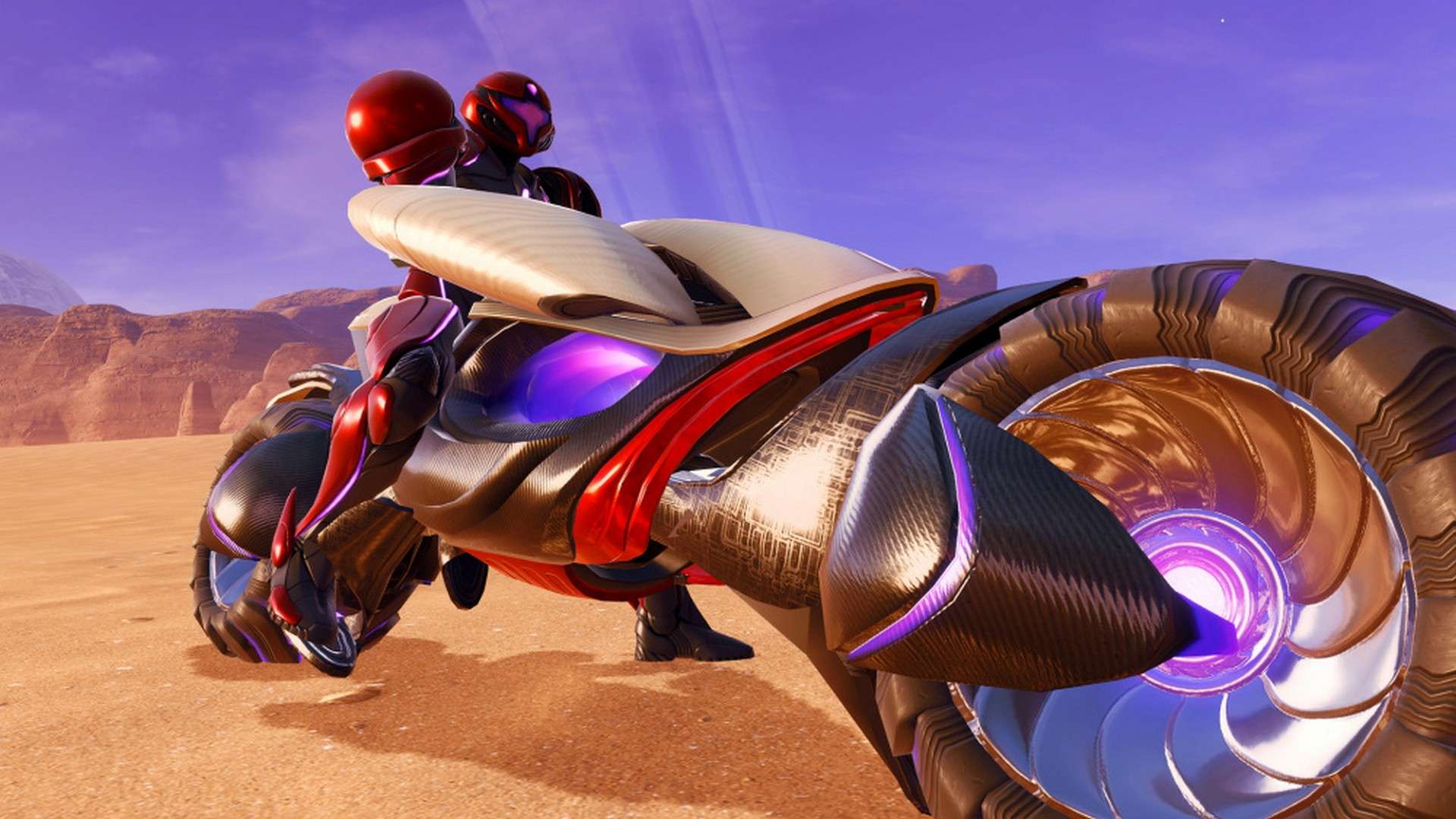
The characters can be a little silly at times, and their AI has a habit of throwing them into danger more often than you’d like, which can get frustrating, but by the end of the game, you genuinely care about them. V, the compassionate Galactic Federation mech pilot, stands out in particular. These companions aren’t the only allies Samus finds along the way. In Volt Forge, she acquires the Vi-O-La Suit, which grants her access to the Vi-O-La Bike, a fast, agile vehicle that becomes essential for traversing Sol Valley, the massive desert at the center of Viewros that I mentioned earlier.
Sol Valley is the weakest part of the game for me. The vast desert is, well, vast and empty, and could’ve at least benefitted from some music; the fact that it’s locked behind an amiibo is a mystery to me. Aside from scattered green crystals and ancient temples, which you’ll smash or explore to earn upgrades and the occasional building tied to side quests, there isn’t much to do beyond riding to your next major destination. It’s not a bad place to switch off your brain and cruise around for a bit, but the novelty wears off quickly. I just wish there was more meaningful content here to make the area feel as alive as the rest of Viewros.
Now, anyone familiar with Metroid knows that progression is a core pillar of the series, and in this game, it’s the best it’s ever been. For newcomers, you’ll quickly notice that each of the five regions contains areas that are blocked off or seemingly unreachable. Don’t worry, you’re not doing anything wrong. More often than not, you’re missing a key upgrade you won’t acquire until potentially hours later. Once you do, you can return to these spots and unlock new paths and often another upgrade waiting for you.
Strengthening the sense of progression are Samus’s new psychic abilities, which add even more depth to her already fun toolkit. The Morph Ball, which I’ll use for this example, gains the Psychic Spider Ball, letting Samus travel along special psychic tracks, while later upgrades include the Psychic Power Bomb. These abilities come into play late into the game, so I won’t spoil the full extent of them here, but Samus’s expanded psychic kit is incredibly fun to use and makes exploration a genuine thrill.
Her arsenal is equally impressive, upgraded through various chips you discover throughout the game. Bringing these back to Myles allows him to add them to Samus’s Arm Cannon, unlocking elemental firing modes alongside her rockets. Combat feels versatile, giving the player freedom to approach encounters however they like. Using the Ice firing mode to freeze enemies before hitting them with the Fire Shot was one I used often. And if you ever feel unsure about an enemy, Samus’s Scan Visor provides a clear breakdown of their weaknesses, keeping the flow of combat intuitive and satisfying.
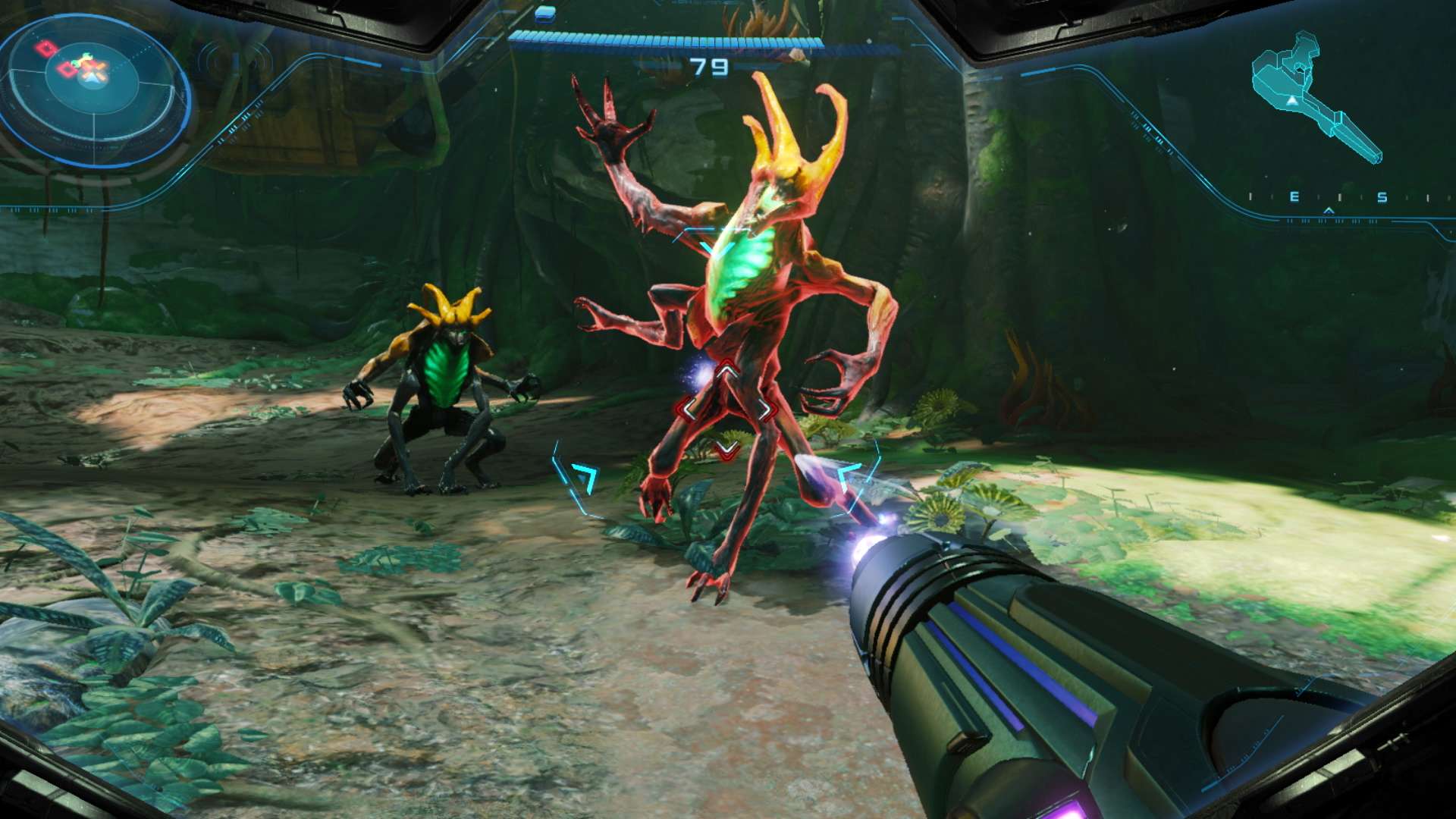
The difficulty could have been a bit higher; I rarely found myself truly challenged, needing to lock in only a handful of times against a few bosses. That said, the boss encounters are exceptionally well designed. My personal favorite is the fight against the massive lava serpent, which has you riding the Vi-O-La across a literal lava lake to target its weak points before climbing onto its back for a final confrontation. It’s a thrilling, cinematic sequence that perfectly blends platforming, combat, and strategy.
Samus’s Scan Visor isn’t limited to enemies; it can be used on nearly anything in the game. While exploring, if you ever find yourself stuck, scanning a vent, wall, or other environmental object will often provide hints or guidance on how to progress, making it a helpful tool without ever feeling like hand-holding.
And perhaps the best part of all, Metroid Prime 4: Beyond is by far the most visually impressive game on the Nintendo Switch 2. In Performance Mode, running at 120 FPS, the game never skips a beat. It’s a great example of what Nintendo’s new hardware is capable of, showcasing both stunning visuals and smooth, responsive gameplay.
The soundtrack, aside from Sol Valley, is haunting and atmospheric, enhancing each area rather than overpowering it. Sci-fi synths and eerie choral arrangements dominate much of the score, while more upbeat, driving tracks during combat heighten the tension and make battles feel truly cinematic.
Overall, Metroid Prime 4: Beyond is a triumph for the series. With its great technical performance, gorgeous visuals, deep exploration, and fun combat, it delivers everything fans have been waiting for. While areas like Sol Valley may feel a little empty, the game’s rich design and rewarding progression make it a must-play in 2025.

The Good
- Gorgeous level design
- Brilliant progression that is a staple of Metroid
- Best looking game on the Switch 2 by far
- Versatile combat
The Bad
- I wish there was more to do in Sol Valley
- NPCs are a bit silly





 SuBZeRO2K
 Spotify
 Anchor
 iTunes