
My first introduction to Katamari was in June 2023 with “We Love Katamari Reroll + Royal Reverie”. With Rengame developing and Bandai Namco Entertainment Inc. publishing “Once Upon A Katamari”, I was eager to revisit the love I felt for the franchise.
“Once Upon A Katamari” has our very well-known characters, The King of All Cosmos, The Queen, and The Prince, cleaning. It is during this task that the King discovers an old scroll. Being as flamboyant as The King always is, he shows off his scroll-spinning techniques, which leads to an accident.
That’s right, The King once again destroys all the stars, including the Earth and the Moon too. To restore the damage, The Prince is tasked with its resurrection once again, but this time, The Prince has to travel through time.
Gameplay hasn’t changed from previous Katamari games; The Prince pushes the big, sticky ball called Katamari, and it grows larger as more items adhere to it. Tasks are given so that The Prince has an objective to reach with each stage. If you have played a Katamari game before, you will find the same gameplay loop here.
These objectives can include reaching a particular size, reaching a particular size within a set time, collecting a specific number of items, and much more. This time, however, objectives felt more difficult, which detracted from the cozy, relaxing feeling I got while playing “We Love Katamari Reroll + Royal Reverie”.
The Prince inhabits the scroll that destroyed the stars and must interact with people on it to enter the stage and repopulate the cosmos. Unfortunately, as The King has destroyed everything, you need to use the S.S. Prince to travel to different places in time.
Each visit to an era unlocks more places on the scroll within that era, as well as new eras and stages in eras that are already unlocked. The eras are all themed, so there is plenty of variety, including the Jurassic Era, the American Frontier, and Edo Japan, to name a few.
So, what makes “Once Upon A Katamari” different? Surprisingly, it’s the little things that have been added, though, when you think about it, when you are playing a game that revolves around growing larger, saying it’s the little things seems weird.
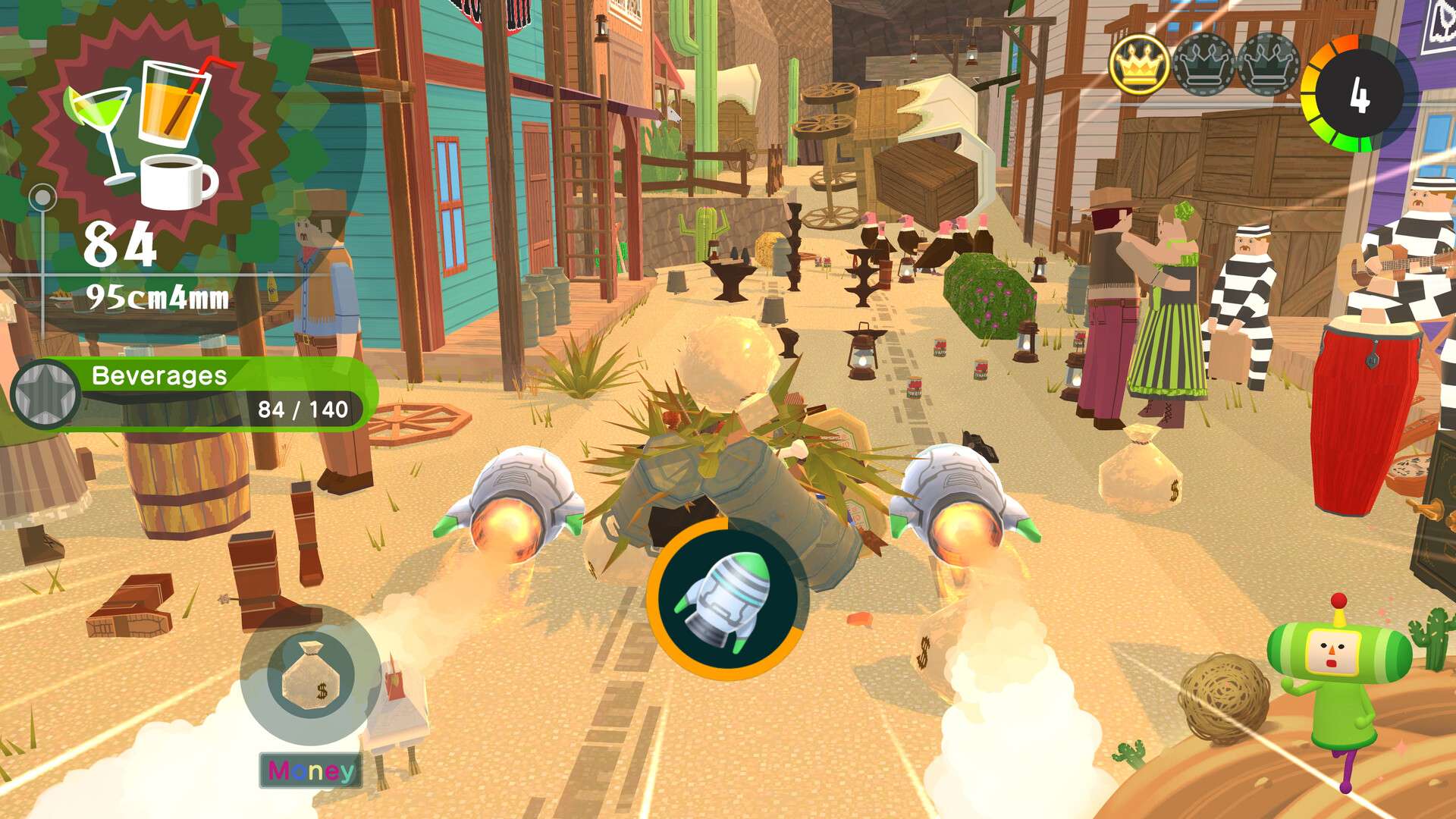
In stages, you can find boosters to help you complete your objectives. Just to name a couple, there is a rocket that propels the Katamari forward at lightning speed, and a magnet that attracts nearby items to the Katamari. Once found, you can also choose to play the stages as Cousins, or even customise a character all of your own.
The customisation expands as you find gifts in the stages, but completing stages and challenges rewards King Tokens. King Tokens can be used in a gacha-type King’s Head Statue to unlock more cosmetics from hats, faces, tops, poses, and much more.
Lastly, multiplayer can allow you to compete with other players in four-versus-four competition. It’s not completely locked out either, so you can still enjoy the competitiveness as CPUs can fill in for missing players, allowing you to continue soloing if you wish.
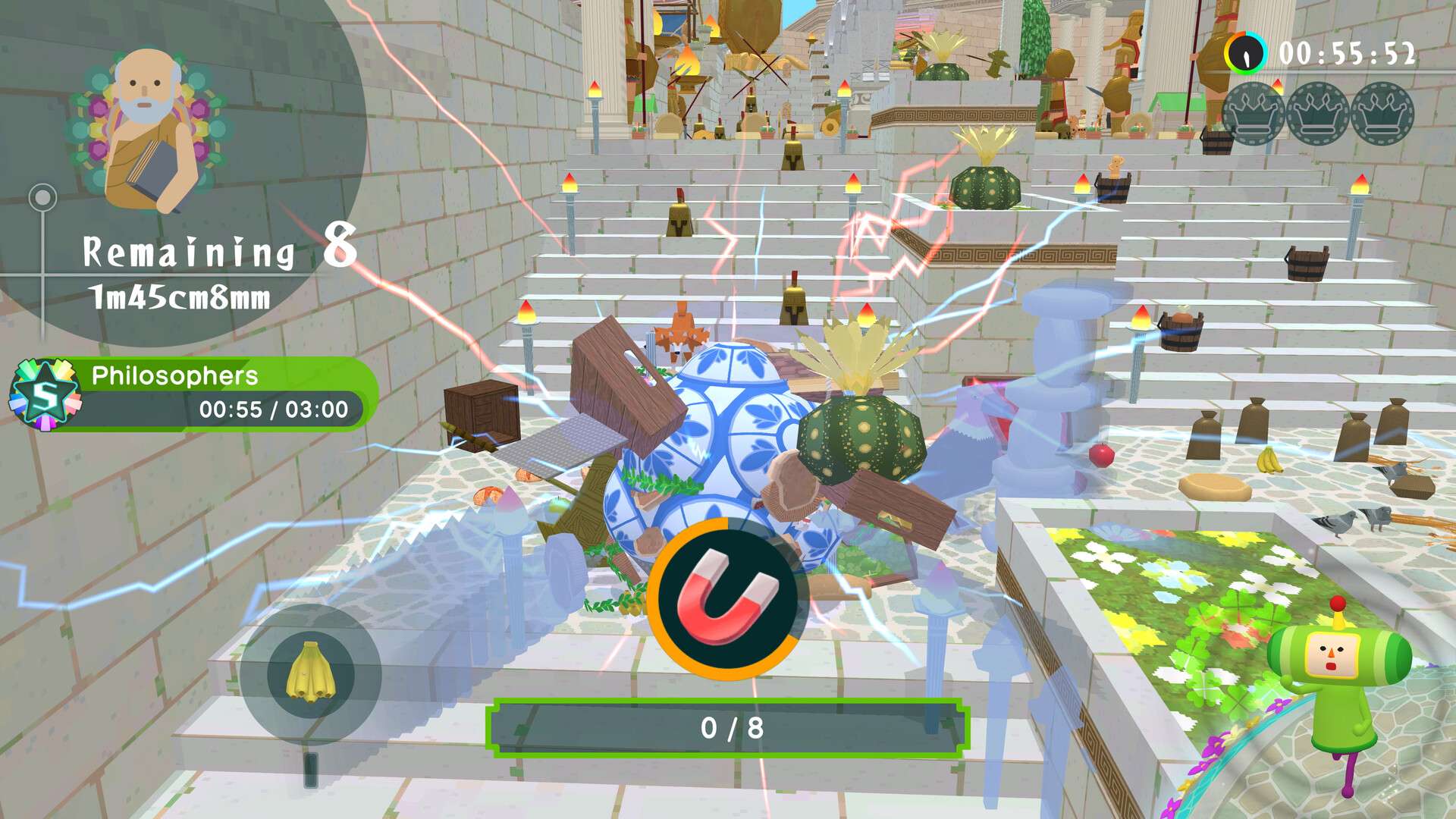
“Once Upon A Katamari” is presented the same way graphically as it always has, with bright, bodacious cartoony colours. Cut scenes play out like a drawn storybook, with the same brightness and charm, while the in-game graphics are more blocky. Moving around the hub world and progressing through stages is fluid, but it still lacks a wider field of view at the start, making it hard to navigate. Once you become more sizable and the camera rolls back, it becomes a more pleasurable experience.
There is no change to the sound effects of “Once Upon A Katamari”, just as with the graphics. As you roll over or bump into things, familiar and bizarre sounds play. Not that any change is needed, as it is just as charming as ever.
The music, however, is a different story. All the new songs are incredible and add to the pleasure of rolling around. I often found myself bopping along to the music.
“Once Upon A Katamari” has a familiar gameplay loop that will be either a positive or a negative, depending on how you feel towards the franchise. New additions to the formula, including boosts, customisation, music, and multiplayer, add something refreshing to the package.
With difficulty feeling a bit harder, it does impact the cozy, relaxing feeling I had come to expect from the franchise. Although it’s not so hard that it becomes a deal breaker, it is something that needs to be considered when you sit down to play.
Overall, “Once Upon A Katamari” rolls above its weight and is a fun game. Whether you are new or old to the franchise, you will have a ball of a time.

The Good
- Incredible music
- Familiar gameplay loop
- Character customisation
The Bad
- Familiar gameplay loop
- Objectives feel more difficult
- Tight field of view at the beginning




 SuBZeRO2K
 Spotify
 Anchor
 iTunes